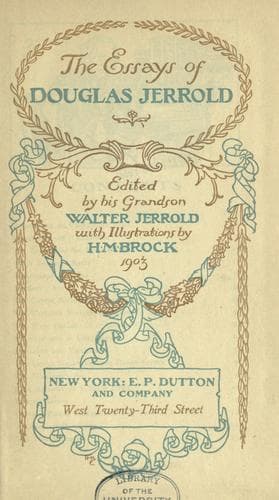
The Essays of Douglas JerroldJerrold, Douglas William
General
The Essays of Douglas Jerrold
Jerrold, Douglas William
English essays -- 19th century
Only a twelvemonth after this, I lost my excellent father. It may prove
to the giddy and the vain the uncertainty of life, when I state that my
worthy parent was in robust health one minute and dead the next. It may
also prove that he had held some place in the world, when I assure the
reader that crowds of people flocked to our house to pay honour to his
cold remains; which, for the benefit of his widow and son, were
exhibited at sixpence a head to grown persons, and half-price for
children. I should be unjust to my parent’s memory were I to withhold
another circumstance illustrative of the consequence of my father to the
world at large: the night-cap in which he died was purchased by a
gentleman, a lover of the fine arts, after a severe contest with other
bidders, for two guineas.
And so much for my uncle and my father, both worthy of the name of
Whitefeather.
CHAPTER II
CAPTAIN WHITEFEATHER TAKES AN ENLARGED VIEW OF SWINDLING. SOCIAL EVILS
AND THEIR REMEDY
NO—the theme is too pregnant with circumstance; too vast—too voluminous.
Let me then subdue the vain, though laudable, ambition—let me repress
the fond, the wild desire of such distinction. Is it for a single pen to
write the History of Swindling? Is it for one man to chronicle, with
scrupulous fidelity, the rise and progress of the exquisite art (for I
must call it so)? Is it for one curious pair of eyes—one toilsome
hand—to pore over and put down the many million facts to be registered
in a complete body of the Science? Could the life of a patriarch, even
though he worked the hours of a cotton-spinner, suffice for the labour?
Consider, Barabbas, what running to and fro—what fetching and carrying
of truths—what sifting and winnowing of chaff and husk—what
gold-washing—what pearl-diving! Now picking up stray matter for your
work in Egypt—now, with a thought, among the sages in India—now off, it
may be, upon a wild-goose chase to Arabia Petræa—now among the
Scandinavians—and now, cold as a snowball, to be called away to the
opium-sellers at the walls of the Tartars! Is it possible for one man,
though with ribs of brass and soles of adamant, to go through the toil
and travel? And this, be it remarked, will only take in the first
thousand years or so of the age of our dear, ill-used mother earth. How
much remains to be done—what crooked ways to thread—what dirt and rust
to scratch away—what inscriptions to guess at—what monuments to
measure—even before you come to Semiramis! And when, reeling like a
porter under a thousand-weight of facts—for a very few facts make a
pound—you arrive at Semiramis, have you disciplined yourself to bear the
indifference of a superficial generation—to be asked by listless
ignorance, “Who the devil is Semiramis?” Dear Barabbas, your yearnings
are indeed most noble; but there is a limit to human action—there is a
point where man must stop. The task is not earthly; or, if indeed it be
Public-domain text, read in full here on John Shaqi.
Reviews
Reviews
No reviews yet
Be the first to share your thoughts on this work.
Elsewhere in the archive
Join the Discussion
Join the discussion
Sign in to leave a comment or review.
Sign InorCreate an account