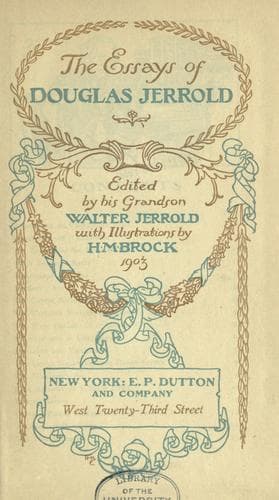
The Essays of Douglas JerroldJerrold, Douglas William
General
The Essays of Douglas Jerrold
Jerrold, Douglas William
English essays -- 19th century
a mortal labour, it is only to be achieved by the united heads and hands
of many. A band of hard-working encyclopædists—temperate labourers
living upon bread and water and figs—might possibly, in the course of a
few lustres, produce some hundred volumes of the work; but a complete
body of swindling from the birth of time to its present lustihood, it is
a thing only to be dreamed of—a glorious phantasm—a magnificent but most
deceitful vision!
But grant it done. Say that the last proof—the ten millionth sheet—lies
before you, the smooth-faced devil waiting at your garret door to carry
off the corrected matter for the press. Say that it is printed,
published, and the whole five hundred volumes folio scrupulously conned,
as they doubtless would be, by the critics—alack! alack!—what a
melancholy book hath the press groaned with—what a ghastly chronicle,
what a blood-dyed, tear-stained record!
“A complete body of swindling!” Let us turn a few of the leaves. They
creak like dungeon hinges! Are not the pictures terrible? Whole
generations of men, thin-chapped, hollow-eyed, scourged and in bonds;
fainting in midday; stark with the dews of night. Tens of thousands,
living carcasses, in mines—thousands and thousands writhing in blood and
agony upon the field—with the vassals of glory, a cloud of vultures,
hovering to pick their bones. Next let us peep through prison bars,
and—no; close the book—it is too shocking—one’s marrow freezes, and the
brain reels at it.
“Methinks,” says the reader, “the Captain takes a too comprehensive view
of his subject.”
Right, sagacious reader; and yet, were the history of swindling in all
its ramifications to be duly chronicled, the work would be no less
voluminous, no jot less tragical. The present is, after all, not an
auspicious age for folios; neither is it the best of all possible eras
for the publication of disagreeable truths. Lazarus himself, to touch
worldly sympathy, should in these days be a Lazarus in superfine
cloth—the best cambric and the glossiest beaver; nay, he would be
something the gainer by a waistcoat of gold-smeared velvet, and, at
least, a chain of silver. To make iniquity or sorrow bearable, it is
highly necessary that it should be properly dressed. Hence, reader, I,
Barabbas Whitefeather, instructed by the better spirit of the age,
forego my first Utopian purpose, and leaving the full history of
swindling to be written by a future college of sages, shall confine
myself more immediately to the existing wants of the world—shall attend
to the crying necessities of the present generation. Controlled by my
better genius, I renounce folios.
Public-domain text, read in full here on John Shaqi.
Reviews
Reviews
No reviews yet
Be the first to share your thoughts on this work.
Elsewhere in the archive
Join the Discussion
Join the discussion
Sign in to leave a comment or review.
Sign InorCreate an account