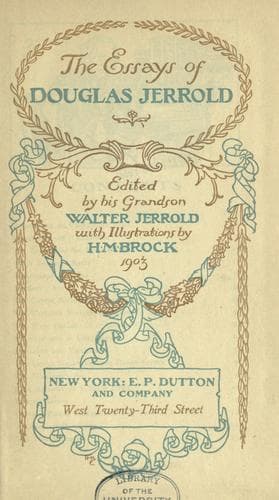
The Essays of Douglas JerroldJerrold, Douglas William
General
The Essays of Douglas Jerrold
Jerrold, Douglas William
English essays -- 19th century
This is the determination of a genius: but even the most consummate wit
may be assisted by the experience of others, and it would be a sorry
affectation in me—it would be worse, it would be a gross injustice to my
fellow-creatures—to deny that from my own observation of life I am
incapable of the dearest services to young gentlemen so curiously placed
as Peter Muddleton.
I have taken a single case; I have adduced one of the humblest examples;
I already see a hundred thousand, many varying in their original rank in
life; but all, at length, compelled by the spirit of the age to take
their stand upon the broad ground of—SWINDLING.
All commercial operations of the present, and certainly of the future
age, do and will tend to place the whole wealth of the country in a few
hands. I am not vain enough to suppose that this book will enjoy a large
daily sale for more than a hundred years; with all the partiality of an
author, I cannot bring myself to expect that the state of society—whose
wants the work is to meet—will endure above another century. However, I
shall have done my duty, and I may safely leave the year 2000 to the
active philanthropy of other WHITEFEATHERS. For more than the next
hundred years there must, if my previous hypotheses are allowed, be an
enormous amount of intelligence unemployed by the professions; the
tangible fat of the land becoming every year engrossed by a smaller
number. Now, to prevent any violent partition of property, it is—I can
lay my hand on my heart and vow it—it is my purpose to make the few
contribute in the easiest and pleasantest way to the wants of the many.
Briefly, it is my object to show to the elegant unemployed how they may
successfully and safely swindle the shopkeeping minority. The whole
system is reduced into a trial of wit; and if the swindler be a man of
real genius, and the man swindled have a touch of generous feeling in
him, he will forget what might be vulgarly called a loss in admiration
of his conqueror. I have seen much of shopkeeping nature; and I am
convinced that a man properly, wholly, and withal delicately
swindled—where there have been no rubs or hitches in the work—that a man
who, with all his eyes and ears about him, has nevertheless, without his
knowing it, been turned, “like a cheveril glove,” inside out by the
professor—that such a man, after the first burst of disappointment,
feels but little of the bitterness of resentment; the small drop of gall
in his heart is speedily taken up, and by a process delightful for the
benevolent mind to consider, is assimilated to the milk of human
kindness still running in the ventricles of the swindled; who—I have
known such an instance—after a moody, savage look, will burst into a
laugh, slap his leg, and with a confident, yea, with an exulting voice,
declare that “no less a swindler could ever have swindled _him_.” Here
is a homage—an irresistible token of admiration—paid to one man; and if
Public-domain text, read in full here on John Shaqi.
Reviews
Reviews
No reviews yet
Be the first to share your thoughts on this work.
Elsewhere in the archive
Join the Discussion
Join the discussion
Sign in to leave a comment or review.
Sign InorCreate an account