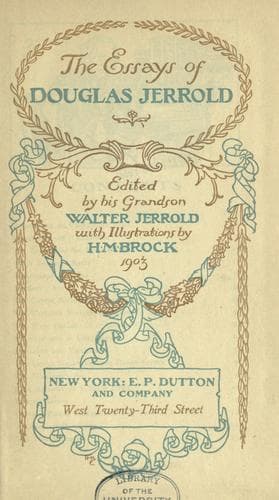
The Essays of Douglas JerroldJerrold, Douglas William
General
The Essays of Douglas Jerrold
Jerrold, Douglas William
English essays -- 19th century
And first for the FACE OF A SWINDLER. Men who set themselves up as
judges of character—I have heard the sciolists—sometimes marvel that the
sons of commerce should so frequently fall victims to some individual
swindler; when he, the party swindling, is one of the most ingenuous
creatures breathing; looking, in fact, the swindler that he is,—when
from his eyebrows to the corners of his lips there is painted in the
largest human capitals the calling of the professor. The truth is, the
unsuspecting men accustomed to pore over day-books and ledgers have not
had sufficient time to learn to read human faces. They can on the
instant, if put to the test, tell a good guinea from a bad one; but
though they shall stare in the features of a human counterfeit for an
hour or more, they cannot, one in a hundred, discover the washed brass
from the true gold. More; though they shall hear the counterfeit—though
the ring of its voice shall be the truest Brummagem—the trading man
shall complacently rub his hands, satisfied that he is hearing the
sweetest sound of the mint.
I confess it, to the honour of the trading community of this commercial
country, I confess it; the success of some faces of my brotherhood upon
men behind counters has been to me startling evidence of the
unsophisticated character of the tradesman. For instance; there is
Nobrowns, Scarceamag, Fleeceington, and others I could name—shall I own
it?—I have sometimes felt myself humiliated by their prosperity. I have
felt the science lowered by the facility with which they have
ingratiated themselves into the favour of the jeweller, the coachmaker,
the tailor. Had _I_ kept shop, I have thought I should have shown
Nobrowns to the door at the first glance of his eye; and without looking
at Scarceamag, but simply hearing his base-metal voice, I should have
told him I had nothing in his way, and straightway ordered him across
the threshold. And yet these men have flourished for a score of years;
and, at this moment, are prosperous swindlers. How is the enigma to be
explained—how the more than Arcadian innocency of the dwellers in Bond
Street and Regent Street to be philosophically accounted for? Is it,
that men immersed in the profound abstraction of £ s. d. lose somewhat
of the sagacity inherited and often improved by poorer souls; that, too
much rapt by the splendid visions of the future profits, they are less
vigilant as to the danger of present credit? Providence, however, hath
wisely partitioned its benefits. If it be given to Scarceamag, with
_his_ face, to swindle and be poor—it is also allotted to Puddingtête,
the tradesman, to be swindled and grow rich. Take this, then, my dear
pupil, for an axiom: you may—since you cannot help it—look the greatest
swindler in life; but if you shall hold your own counsel, your face
shall, at least to the acute men behind counters, never reveal it.
Tradesmen can read anything but customers’ faces.[12] This truth is
Public-domain text, read in full here on John Shaqi.
Reviews
Reviews
No reviews yet
Be the first to share your thoughts on this work.
Elsewhere in the archive
Join the Discussion
Join the discussion
Sign in to leave a comment or review.
Sign InorCreate an account