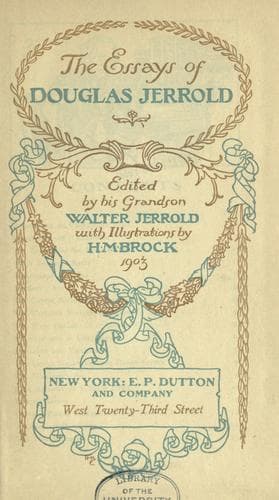
The Essays of Douglas JerroldJerrold, Douglas William
General
The Essays of Douglas Jerrold
Jerrold, Douglas William
English essays -- 19th century
every day borne out by the success of fellows whose features have gone
far to vulgarise the science. Ragamuffins who ought never to have
aspired beyond the pea-and-thimble board at a country fair—knaves marked
and impressed by the truthful hand of nature for the lowest offices of
legerdemain have, trusting to the simplicity, the unsuspecting
ingenuousness of a money-getting generation, to the marvellous innocency
of the commercial body, made for themselves a reputation of the first
class, or of very nearly the first class of the highest profession.
Ultimately, in the advancement of society, these vulgar upstarts will be
met by a greater number of competitors, elevated and accomplished with
the graces of life, and the term swindler will be, as it ought to be,
synonymous with gentleman. The commercial faculty will, on the other
hand, be rendered more acute in its observation of human character;
hence it will require a greater delicacy of style—more imposing and a
more winning manner to arrive at any distinction—indeed, even to make a
clear paltry five hundred a year as a swindler, than in these times will
suffice to ensure to a tolerably industrious man an income of a
thousand. This is inevitable. When the tens of thousands of noble
spirits, heretofore absorbed by the professions, are left to trade upon
their wits—when all society is more strongly marked, more arbitrarily
divided into two classes, the swindlers and the swindled—when, instead
of a violent and ruthless division of property, as infamously as
ignorantly insisted upon by certain firebrands—there is a graceful
exchange of elegant patronage on the one side, and a profound expression
of thanksgiving respect on the other, the character of the successful
swindler will rise to its ordained and natural elevation, and a
Whitefeather (pardon the honest vanity) take his place with many
illustrious names sufficiently obvious to the philosophical reader. The
time is happily passing away when brute violence is to achieve national
good—when the price of bread is to be beaten down by a bludgeon, or
wages raised upon a pike. It is therefore a matter of deep regret to the
contemplative man, and such I am not ashamed to confess myself, to
perceive how many gifted persons are, by a premature nativity,
ill-placed. How many men at the present day breathing national arson and
patriotic pillage—men who have so profoundly studied the _meum_, that
they are entirely ignorant of that of _tuum_—would, born a few years
hence, have shed a lustre, have conferred a dignity upon even an
illustrious and dignified profession. Let me not be asked to enumerate
examples—I eschew the personal for the general. It is enough that the
eye of the philosopher can perceive in many a sulphureous patriot the
indefatigable swindler; that the sage, pondering on the inevitable
changes of society, can detect in a present Bull-ring Brutus all the
misapplied qualities of a future Isaac Solomons!
Footnote 12:
Public-domain text, read in full here on John Shaqi.
Reviews
Reviews
No reviews yet
Be the first to share your thoughts on this work.
Elsewhere in the archive
Join the Discussion
Join the discussion
Sign in to leave a comment or review.
Sign InorCreate an account