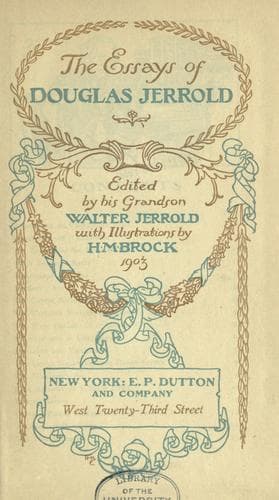
The Essays of Douglas JerroldJerrold, Douglas William
General
The Essays of Douglas Jerrold
Jerrold, Douglas William
English essays -- 19th century
It will be seen that the Captain had some knowledge of Chaucer.—[JOHN
JACKDAW, Ed.]
The swindler whirls away from the tradesman, who has attended him,
bareheaded, to the kerbstone, and then the man of precious metals
returns to his shop in that delightful serenity of mind, apt, I am told,
to possess people with profits ranging from fifty to seventy-five in the
hundred.
What—it will be asked—what, does Mr Giltspur, the silversmith, without
further questions put, trust his service of plate, besides a magnificent
suite of amethysts (for which the honourable Mr Thug expressed a sudden
liking), to the honour of his customer? To be sure he does; and his
blood simmering with a sense of profit, he orders them to be delivered
at “——— Hotel,” where Mr Thug is staying; but which delightful and
convenient hostelry he, shortly afterwards, suddenly leaves on the most
imperative business. A thousand instances bear out the probability of
Thug’s success and Giltspur’s discomfiture. People may talk about the
innocence of a pastoral age: I am, from long experience, convinced of
it, that the most innocent, the most unsuspecting, the most easily-taken
biped on the face of the earth is—your London shopkeeper. Armed with
proper weapons, it is almost impossible that he can escape you. The poor
creature is weakness, imbecility itself; “Wear your eye thus,” and as
surely as the fluttering bird drops into the mouth of the snake, as
surely fall the tribe of Giltspurs into the folds of the Thugs.
Well, and is it not delightful that it should be so? Here is Giltspur,
for a certain number of days at least, made very happy; he has delivered
his goods, and has already calculated to the odd sevenpence-halfpenny
the amount of profit. Thug has conferred upon him a great
pleasure—passing, it must be owned—but sweet, very sweet, whilst it
endures.
Does the reader still remember the picture of violence drawn in a former
page? Does he still behold the pallid silversmith—his fainting wife—and
blushing daughters? Does he yet hear the roar of the flames, as they
come up the staircase—the fury of pillage in the shop below?
The same effect is produced by the swindler, but how different the
cause! The “division of property” is just as complete—the fine, deep
philosophy that preaches it equally well honoured; and yet, what grace
on one side—what civility on the other; and, to one party at least, what
tangible, enduring satisfaction! Who, then, with the smallest spark of
human dignity within him would stoop to violence when he may “divide”
with ease? The “multiplication” of the human animal is, indeed,
according to the modern school-men, “vexation”; but the “division” of
property—unless divided on the bland principles of swindling—would be
infinitely worse. In the progress of society, then, it is by swindling,
and by swindling only, that we shall escape the most grievous
revolution.
Public-domain text, read in full here on John Shaqi.
Reviews
Reviews
No reviews yet
Be the first to share your thoughts on this work.
Elsewhere in the archive
Join the Discussion
Join the discussion
Sign in to leave a comment or review.
Sign InorCreate an account