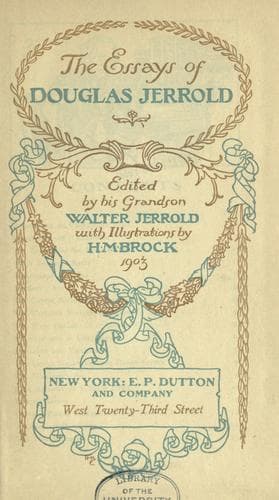
The Essays of Douglas JerroldJerrold, Douglas William
General
The Essays of Douglas Jerrold
Jerrold, Douglas William
English essays -- 19th century
I had not touched upon this mean-spirited class of bipeds—of the
species, many of whom die off in honourable poverty, and many in a
dishonourable horse-pond—did not swindling save a third portion of the
body from a life of starvation and an end of vulgar misery. The good,
indulgent parents who, in submission, as they conceive, to the high
civilisation of the day, will rather let their sons be nothing if they
cannot put them in a fair way to become archbishops, chancellors, and
commanders-in-chief, owe much to swindling, for—urbane goddess!—how
often does she take the pet of the fireside—the darling of the chimney
corner—the pretty prodigal, when plucked of every feather by the
jackdaws[18] of the town, and make of him again a bird of finest
plumage. Yes, thousands and thousands of young gentlemen, shamefully
deserted by their parents when they had not a farthing more to leave
them, and—wanting a calling—with nothing to do, have been received with
open arms by the tenderest of foster-mothers; and not only once more set
upon their legs, but, perhaps, for the first time in their lives, put
into their own cabriolets! Little thinks the plodding tradesman,
determined upon making Tom a gentleman, that his dear boy may owe all
the external appearances of that character to nought but swindling. But
I have wandered.
Footnote 18:
I persuade myself that Captain Whitefeather here meant nothing
personal.—[JOHN JACKDAW, Ed.]
The swindler must dress well—very well; nay, he must be rather
over-dressed than under-dressed. If his means be scanty, he must on the
outset, if I may use the phrase of a celebrated bill discounter, late of
the New Cut—he must “spend his money superficially”; that is, as the
before-named fiscal authority condescended to explain, he must expend a
little in such a way that the outlay may appear very considerable. He
must, however, continually bear this in mind, that in this our beloved
country—in England—the empress of nations—the queen of reason—the genius
of toleration—and the benefactress of the oppressed—nearly everything
depends upon a man’s coat. Great and rich is he indeed who can afford to
confront the midday sun in threadbare cloth. It matters not what may be
your genius—what your worth; you must make the success of that genius
apparent—you must publish the reward of that worth; you must assure
men’s eyes that you are a fine gentleman, or you will, with all your
glorious aspiration, be passed, confounded with the mob. The triumphs of
mind are to the trading million too subtle, too abstract, to be easily
grasped; but the quality of a man’s coat—the gorgeousness of his
vest—the chain of finest carat—the ring of brightest sparkle—all of
these are so many indisputable evidences of worldly success, and are,
therefore, to be continually carried about by a man as universal
vouchers for his character. John Bull has certainly the largest eyes of
any of the nations. Hence, if it be imperative upon men with even a
Public-domain text, read in full here on John Shaqi.
Reviews
Reviews
No reviews yet
Be the first to share your thoughts on this work.
Elsewhere in the archive
Join the Discussion
Join the discussion
Sign in to leave a comment or review.
Sign InorCreate an account