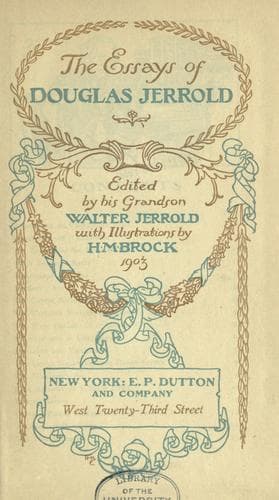
The Essays of Douglas JerroldJerrold, Douglas William
General
The Essays of Douglas Jerrold
Jerrold, Douglas William
English essays -- 19th century
known calling to exhibit an outward sign of the prosperity of that
craft, how much more is it incumbent on us—the minions of Mercury, with
nothing but the vivacity of our wits “to feed and clothe” us—to put a
splendid outside upon swindling, and since the world ducks to
appearance, to assure ourselves of its very, very lowest stooping! I
have never yet known an instance of a successful swindler in a shabby
coat. Who, indeed, would trust a man with a hole in his hat? Read the
Police Reports—those “short and simple annals”—how, nineteen times out
of twenty, do they commence? Why, thus—“Algernon Mountedgecomb, a young
man dressed in the highest style of fashion,” etc., etc. Such is always
the strain; for can the reader point out any case with any verbal
similarity to the following:—“Yesterday, John Snooks, a wretchedly
attired fellow, was brought up charged with obtaining under false
pretences a diamond ring, a gold repeater, and a suit of pearls from the
house of——?” Has ever such a case been chronicled? Certainly not: hence,
the tailor is indispensable to the swindler, who is on no account to
spare him. The swindler may, in the weakness of his nature, have some
qualms towards any one except a tailor; but the swindler who deals
mercifully with a tailor had better seek another profession—such
chicken-heartedness is not for our art. The benevolence is so much
goodness lost—wasted—flung to the winds; for you are to bear with you
this recollection: it is an axiom in his trade, that the tailor never
loses. “Them as does pay”—such was the confession of an eminent
coatmaker after his second bottle of Burgundy drank at Button Park, his
country seat—“them as does pay,” said the good man, “pays for them as
doesn’t.” Can there be a finer provision for the protection of trade,
and the satisfaction of the non-paying? Hence, if possible, flay your
tailor. Should he discount—for there are such philanthropists—let him
have a few bills by all means. In his vast profits what are two or three
thousands more or less in a twelvemonth’s balance? _If_, however, he
will not discount the paper of your friends—“accommodate” is a good
word—he cannot refuse your own bill. Great is the satisfaction of a
bill! What serenity comes upon a man’s soul when he hath writ
“accepted”! What a load he feels lifted from his lightened heart! How
airily, how joyously he looks around him, elevated with a sense of duty
done to his neighbour and to himself! Sweet, most sweet, the
satisfaction! Such I am sure was the feeling of my late lamented friend,
Captain Judas Gammon; for that excellent fellow never accepted a bill
that he did not clasp his hands and, raising his eyes with a devout look
of thanksgiving, exclaim, “There now—thank heaven—! that’s paid!”
Public-domain text, read in full here on John Shaqi.
Reviews
Reviews
No reviews yet
Be the first to share your thoughts on this work.
Elsewhere in the archive
Join the Discussion
Join the discussion
Sign in to leave a comment or review.
Sign InorCreate an account