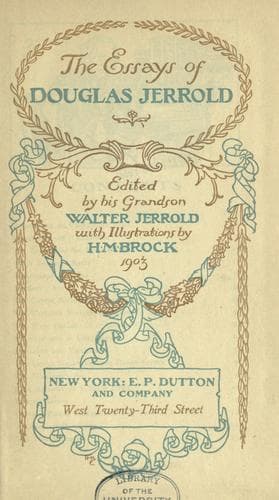
The Essays of Douglas JerroldJerrold, Douglas William
General
The Essays of Douglas Jerrold
Jerrold, Douglas William
English essays -- 19th century
When the plodding, sober, thrifty man quits this noisy world—made noisy
by the incessant rattling of pounds, shillings, and pence—it is ten to
one that he makes what is generally called an irreparable gap in a large
circle of the most affectionate of friends. He leaves a widow
broken-hearted—daughters inconsolable—sons in the deepest
affliction—nieces and nephews very much concerned—and innumerable
acquaintances all ready, with very little further excitement, to burst
into tears. Now here is a woe inflicted upon fifty people by the decease
of one man—yes, here are fifty people made more or less miserable by a
very natural event, the decease of a worthy soul, who would not
willingly inflict a moment’s pain upon any living thing.
How different the death of the swindler! He makes no irreparable gap in
society—not he! he agonises neither man, nor woman, nor child; not a
tear is dropped at his grave—not a sigh rises at the earth rattling on
his coffin! Must not the conviction of this be the sweetest consolation
to the dying swindler? Think of his end, and——
* * * * *
[It may be thought that the work ends abruptly. It does so: the author
had not leisure to finish it. The following letter will, perhaps, throw
some light upon the matter. It was addressed by the Captain to an
intimate friend:—
“H.M. Transport, _Barrington_.
“DEAR TOM,—We are off for blue water. Some papers of mine are in
a deal box in the two-pair back of the Bag-o-Nails. If you love
me, see I’m in print. I learn from a fellow-shipmate—whose only
misfortune is that his handwriting was very similar to another
gentleman’s—that the papers will make a very pretty book, there
being a great call nowadays for the greatest information in the
smallest compass. You can pay in for me what you get through the
Home Office. Be wide awake, and believe me, under all
convictions,
“Yours truly,
“BARABBAS WHITEFEATHER.
“P.S.—You know I never liked shaving; the chin’s bad enough—but
when it comes to the head, it’s ‘regular cruelty to animals.’”
The above is (“errors excepted”) a true copy of the Captain’s letter. He
died in—I regret to say I cannot give the exact latitude: suffice it to
say he died; but left behind him what, I trust, will prove an
imperishable monument of his social worth and his exalted genius.—JOHN
JACKDAW, Ed.]
THE EDITOR’S CHAPTER TO THE READER
THE reader has, probably, marked a variety of style in the foregoing
pages. The Editor feels it to be due as much to the lamented Captain
Whitefeather as to himself to state that he, John Jackdaw, is solely
responsible for the manner in which this work is presented to all the
eyes of the British public.
Public-domain text, read in full here on John Shaqi.
Reviews
Reviews
No reviews yet
Be the first to share your thoughts on this work.
Elsewhere in the archive
Join the Discussion
Join the discussion
Sign in to leave a comment or review.
Sign InorCreate an account