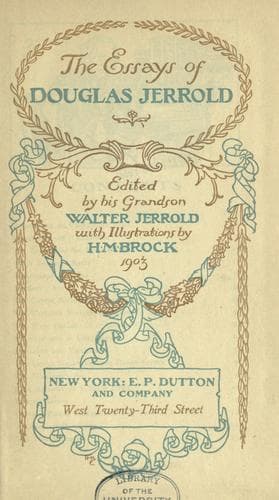
The Essays of Douglas JerroldJerrold, Douglas William
General
The Essays of Douglas Jerrold
Jerrold, Douglas William
English essays -- 19th century
Nature had been very prodigal to the Captain; but whether from the
extreme vivacity of his genius, or whether from a more hidden cause, it
is vain to search, the Captain, with all his debts, owed nothing to art.
Even his orthography was of the happiest originality.
The Editor, therefore, felt the peculiar delicacy of his task. Had he
printed the MS. as it came, with the bloom upon it, from the Captain’s
hand, it was to be feared that in this age of light reading—which
reading, like pills, is made to be bolted, not, like bread, to be
carefully chewed—not one out of a hundred would have had the necessary
patience to go through with it. To suppress the work for any defect of
style would have been to sacrifice, as the Editor considered, a great
national good. After much deliberation there appeared to him a golden
mean. It struck the Editor that he might, in very many instances, give
the style of Whitefeather, whilst in very many more he might heighten,
and adorn, and vary it from his own poor resources. Still, be it
understood, all the _facts_ are Whitefeather’s; the Editor only lays
claim to certain tropes, and metaphors, and inimitable felicities of
expression, to which, probably, it might be considered indelicate were
he more emphatically to allude. Indeed, he has only touched upon the
theme in the way of business; as there may be, even at this moment, many
noble and distinguished authors who, “wanting the accomplishment” of
grammar, are yet desirous of appearing in print. (To these, in
parenthesis, the author addresses himself; assuring the tadpole
_literati_ that he finishes tales, histories, biographies, poems, etc.,
with all despatch, and with the most inviolable secrecy. His address is
in a former page, and Breakneck Steps is too well known to all who would
mount Parnassus.)
To the publishers of the remains of Captain Whitefeather the Editor has
to express his warmest gratitude. The Editor blushes for the
intelligence of the trade, when he states that this national work, like
the hitherto inimitable _Robinson Crusoe_, was offered in the humblest
manner to twenty houses, and, sometimes coldly, sometimes sulkily,
sometimes indignantly refused.
Public-domain text, read in full here on John Shaqi.
Reviews
Reviews
No reviews yet
Be the first to share your thoughts on this work.
Elsewhere in the archive
Join the Discussion
Join the discussion
Sign in to leave a comment or review.
Sign InorCreate an account