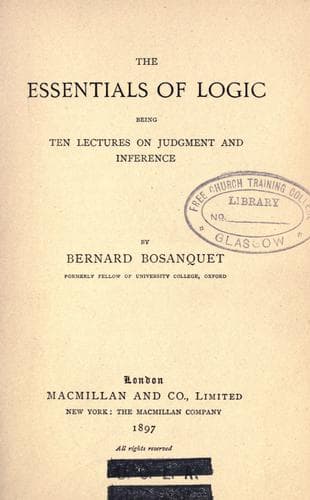
The Essentials of Logic, Being Ten Lectures on Judgment and InferenceBosanquet, Bernard
Philosophy
The Essentials of Logic, Being Ten Lectures on Judgment and Inference
Bosanquet, Bernard
Logic
“Nor is it possible to obtain scientific knowledge by way
sense-perception. For even if sense-perception reveals a certain
character in its object, yet we necessarily perceive _this_, _here_,
and _now_. The universal, which is throughout all, it is impossible to
perceive; for it is not a this-now; if it had been it would not have
been universal, for what is always and everywhere we call universal.
Since then demonstration (science) is universal, and such elements it
is impossible to perceive by sense, it is plain that we cannot obtain
scientific knowledge by way of sense. But it is clear that even if we
had been able to perceive by sense [_e.g._ by measurement] that the
three angles of a triangle are equal to two right angles, we should
still have had to search for a demonstration, and should not, as some
say, have known it scientifically (without one); for we necessarily
perceive in particular cases only, but science comes by knowing the
universal. Wherefore if we could have been on the moon, and seen the
earth coming between it and the {155} sun, we should not (by that mere
perception) have _known_ the cause of the eclipse. Not but what by
seeing this frequently happen we should have grasped the universal,
and obtained a demonstration; for the universal becomes evident out
of a plurality of particulars, and the universal is valuable because
it reveals the cause;” and again, [2] “And that the search of science
is for the middle term is made plain in those cases in which the
middle term is perceptible to sense. For we search where we have had
no perception,--as for the reason (or middle term) of an eclipse,--to
know if there is a reason or not. But if we had been upon the moon, we
should not have had to inquire if the process (of an eclipse as such,
and not some other kind of darkness) takes place, or for what reason,
but both would have been plain at once. The perception would have been,
‘The earth is now coming between,’ carrying with it the obvious fact,
‘The moon is now suffering an eclipse,’ and _out of this_ the universal
(connection) would have arisen.”
[1] Aristotle, _An. Post._ 87, b. 28. [2] _Ibid._ 90, a. 24.
_Analogy_
(_e_) I showed you a method on the way to this in the shape of
Aristotle’s second figure, which we may call _analogy_. The plain sign
of it is, that you give up counting the instances and begin to weigh
them, so that the attributes which are predicates fall into the middle
term or reason. In the former inference about influenza we did not
suppose that you had any idea _why_ influenza was a serious illness;
but in analogy there is some suggestion of this kind, so that the
connection is examined into. Here at once you begin to get suggested
explanations and confirmation from the {156} system of knowledge. You
cannot have analogy by merely counting attributes.
I begin from _Enumerative Suggestion_ drawn from observation of
Butterflies.
1. Three species of genus _x_ closely resemble three species of _y_.
Public-domain text, read in full here on John Shaqi.
Reviews
Reviews
No reviews yet
Be the first to share your thoughts on this work.
Elsewhere in the archive
Join the Discussion
Join the discussion
Sign in to leave a comment or review.
Sign InorCreate an account