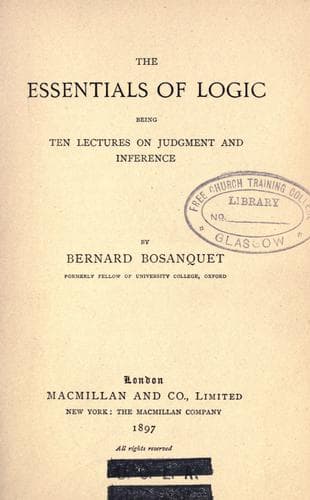
The Essentials of Logic, Being Ten Lectures on Judgment and InferenceBosanquet, Bernard
Philosophy
The Essentials of Logic, Being Ten Lectures on Judgment and Inference
Bosanquet, Bernard
Logic
(_c_) _Mere_ counting or “enumeration” only helps you in induction by
comparison with some other numerical result, and, if imperfect, only to
the extent of suggesting that there {153} is a common cause or there is
not a common cause. _E.g._ if you throw a six with one die fifty times
running, you infer that the die is probably loaded. This is because
you compare the result with that which you expect if the die is fair,
viz. a six once in every six throws. You infer that there is a special
cause favouring one side. The principle is that ignorance is impartial.
If you know no reason for one case more than another, you take them
as equal fractions of reality; if results are not equal fractions
of reality, you infer a special reason favouring one case. [1] Pure
counting cannot help you in Induction in any way but this. _Perfect
Induction_ simply means that the total is limited and the limit is
reached; you have counted 100 per cent, of the possible cases, and the
chance becomes certainty. The result is a mere collective judgment.
[1] See Lecture IX, p. 144, note.
_System_
(_d_) The principle of scientific system is quite a different thing.
Essentially, it has nothing to do with number or with a generalised
conclusion. It is merely this, “What is once true is always true, and
what is not true never was true.” The aim of scientific induction is
to find out “What _is_ true,” _i.e._ what is consistent with the given
system. We never doubt this principle; if we did we could have no
science. If observation contradicts our best-established scientific
laws, and we cannot suppose an error in the observation, we must
infer that the law was wrongly, _i.e._ untruly stated. Therefore, as
Mill says, one case is enough, _if_ you can find the truth about it.
People object that you cannot make a whole science out of one case,
and therefore you must have a number of instances. That is a {154}
_practical_ point to be borne in mind, but it has no real scientific
meaning. “Instance” cannot be defined except as one observation, which
is a purely accidental limitation. The point is, that you use your
instances not by counting cases of given terms, but by ascertaining
what the terms really are (_i.e._ modifying them), and what is their
real connection. This is the simple secret of Mill’s struggle to base
scientific Induction, on Induction by simple Enumeration; the latter is
not the evidence, but the beginning of eliciting the evidence--so that
the Scientific Induction is far more certain than that on which Mill
bases it. Aristotle’s statement is the clearest and profoundest that
has ever been made. [1]
Public-domain text, read in full here on John Shaqi.
Reviews
Reviews
No reviews yet
Be the first to share your thoughts on this work.
Elsewhere in the archive
Join the Discussion
Join the discussion
Sign in to leave a comment or review.
Sign InorCreate an account