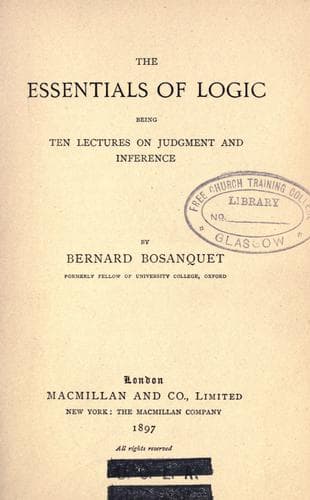
The Essentials of Logic, Being Ten Lectures on Judgment and InferenceBosanquet, Bernard
Philosophy
The Essentials of Logic, Being Ten Lectures on Judgment and Inference
Bosanquet, Bernard
Logic
(_c_) But then our troubles are not ended. Only the essential and
invariable conditions enter into the cause, if the {165} cause is
invariable. This begins to cut away the particular circumstances of
the case. You need not use the trigger, nor even the cap; you may
ignite powder in many ways. You may have many kinds of explosives. All
that is essential is to have an explosion of a certain force and not
too great rapidity. Then you will get this paradox. What is merely
essential to the effect, is always something less than any combination
of real “things” which will produce the effect, because every real
thing has many properties irrelevant to this particular effect. So,
_if the cause means something real_, as a material object is real, it
cannot be invariable and essential. If it is not something real, and
is essential, it fines down into a reason or law--the antecedent in a
hypothetical judgment.
_Ground, or real system with known laws_
(_d_) We can only escape this by identifying both cause and reason
with the complete ground; that is, the nature of a system of reality
within which the cause and effect both lie. But even then, though the
ground is _real_, it is not antecedent in time. We see, indeed, that
the conditions of an effect must be continuous through the effect. If
the process were taken as cut in two at any point, its connection would
be destroyed. If _a_ cause and _b_ effect were really detached events,
what difference could it make if, instead of _a_, _c_ preceded _b_?
_Postulate of Knowledge_
4. The postulate of Knowledge, then, is very badly stated as
Uniformity of Nature. That was due to the vulgar notion of Inductive
“generalisation.” It must be stated in two parts: first, “Once true
always true;” and secondly, “Our truth is enough for us,” that is, it
covers enough of the universe for our practical and theoretical needs.
The {166} two parts may be put together by saying, “The universe is a
rational system,” taking rational to mean not only of such a nature
that it can be known by intelligence, but further of such a nature that
it can be known and handled by our intelligence.
_Conclusion_
5. These lectures have been unavoidably descriptive rather than
thorough, and yet, as I warned you, descriptive of properties which
are in a sense not at all new, but quite familiar, and even trite. You
will not feel, at first, that the full interest which I claimed for
the science of knowledge, really attaches to these dry relations of
abstract thought. You will get no permanent good unless you carry the
study forward for yourselves, and use these ideas as a clue to find
your bearings in the great world of knowledge.
Public-domain text, read in full here on John Shaqi.
Reviews
Reviews
No reviews yet
Be the first to share your thoughts on this work.
Elsewhere in the archive
Join the Discussion
Join the discussion
Sign in to leave a comment or review.
Sign InorCreate an account