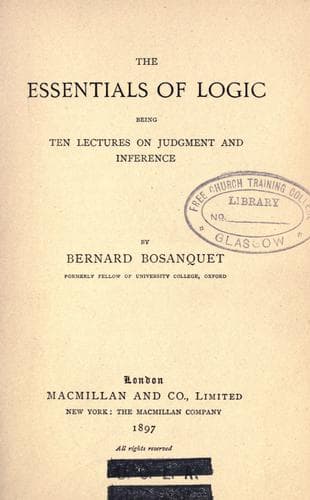
The Essentials of Logic, Being Ten Lectures on Judgment and InferenceBosanquet, Bernard
Philosophy
The Essentials of Logic, Being Ten Lectures on Judgment and Inference
Bosanquet, Bernard
Logic
(_a_) Subsumption is argument by subject and attribute; _i.e._ when
we do not know the system so as to construct the detail,--_e.g._ a
man’s character,--and can only state _in_ what individual system the
details occur. Then we _really want_ the major premise to lay down the
properties of the system, and all deduction _can_ therefore be employed
with a major premise, _e.g._ a mathematical argument might ultimately
take the form, “_space is such that_ two parallels cannot meet.”
_Construction_
But (_b_) when the nature of the subject is very obvious, and
the combinations in it very definite, then the major premise is
superfluous, and adds nothing to the elements of the combination.
“A to right of B, B to right of C.
∴ A to right of C.”
This is clear, but it is not formal; as a syllogism it has four terms.
It is simply a construction in a series of which the nature is obvious.
And if you insert a major premise it would be, “What is to the right
of anything is to the right {164} of that which the former is to the
right of,” and that is simply the nature of the series implied in the
inference stated in an abstract form. “Inference is a construction
followed by an intuition.” [1] The construction, I think, however,
must be a stage of the intuition. I am therefore inclined to suggest
that a factor of general insight into principle is neglected in this
definition, from which much may undoubtedly be learned.
[1] Bradley, _Principles of Logic_, p. 235.
_Causation_
3. I have said very little about causation. The fact is, that in
Logic the cause necessarily fades away into the reason, that is, the
explanation. If we follow Mill’s account, we see how this takes place.
I will put the stages very briefly.
_Cause_
(_a_) We start, no doubt, by thinking of a cause as a real event in
time, the priority of which is the condition of another event, the
effect. Pull the trigger--cause--and the gun goes off--effect.
_Complete conditions_
(_b_) The moment we look closer at it, we see that this will not
do, and we begin to say with Mill, that the cause is the antecedent
which includes _all_ the conditions of the effect. The plurality of
alternative causes breaks down, through the conditions defining the
effect. Pull the trigger?--yes, but the cartridge must be in its place,
the striker must be straight, the cap must be in order, the powder must
be dry and chemically fit, and so on, and so on, till it becomes pretty
clear that the cause is a system of circumstances which include the
effect.
_Law_
Public-domain text, read in full here on John Shaqi.
Reviews
Reviews
No reviews yet
Be the first to share your thoughts on this work.
Elsewhere in the archive
Join the Discussion
Join the discussion
Sign in to leave a comment or review.
Sign InorCreate an account