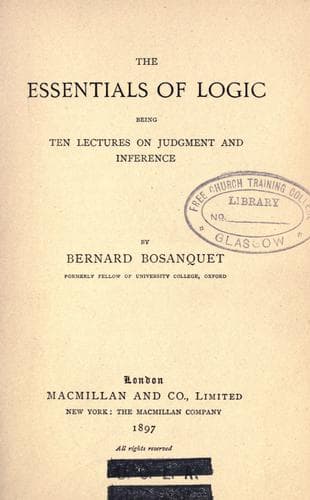
The Essentials of Logic, Being Ten Lectures on Judgment and Inference — John Shaqi
The Essentials of Logic, Being Ten Lectures on Judgment and InferenceBosanquet, Bernard
Philosophy
The Essentials of Logic, Being Ten Lectures on Judgment and Inference
Bosanquet, Bernard
Logic
We begin to see, then, how the nature of knowledge meets the puzzle
which I stated above. How, I asked, can a connected “world,” whose
parts act on one another quite independently of my perception, be in
my individual mind? I answer that it does not follow, because the
world _is for me_ {13} only in my presentation, that my presentation
is the only thing which goes on in the world. “What I am obliged to
think” may represent a real development depending on laws and a system
which is not confined to my individual course of consciousness. The
“objective” in this sense is for Logic an assumption, or rather a fact
to be analysed. We do not attempt to prove its existence, except in the
sense of calling attention to its nature in detail. It will be seen
that “outside the mind” ceases, on this view of objectivity, to have
meaning as regards anything that can be related to us. “Outside” is a
relation of bodies to one another; but everything, about which we can
so much as ask a question, is so far inside the mind, _i.e._ given in
its continuum of presentation or idea.
I will recapitulate the three conceptions of the “objective.”
(1) According to practical “common sense” the objective is independent
of our consciousness in the sense that the presence or absence of our
consciousness makes no difference to the operation of things upon each
other.
(2) According to “common-sense theory” the objective is independent
of our consciousness in the sense that the presence or absence of our
consciousness makes no difference in the mode of being of things (viz.
that the world in consciousness approaches objectivity by resembling or
reproducing a similar and quite objective world outside consciousness).
(3) According to philosophical theory the objective is independent of
our consciousness in the sense that it is what we are constrained to
think in order to make our consciousness consistent with itself. “What
we are constrained to {14} think” is not confined, in its _reference_
to our thought, or to thought at all.
_Our separate worlds._
Public-domain text, read in full here on John Shaqi.
Reviews
Reviews
No reviews yet
Be the first to share your thoughts on this work.
Join the Discussion
Join the discussion
Sign in to leave a comment or review.
Sign InorCreate an account