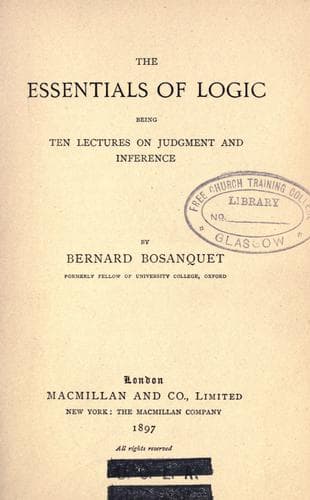
The Essentials of Logic, Being Ten Lectures on Judgment and InferenceBosanquet, Bernard
Philosophy
The Essentials of Logic, Being Ten Lectures on Judgment and Inference
Bosanquet, Bernard
Logic
2. We cannot hope to vanquish this difficulty unless we face it boldly
from the first. There are in the old-fashioned Logic-books tricks and
puzzles, fallacies and repartees, which can in some degree be made
amusing; but of these I do not intend to speak. The course by which
alone I can hope honestly to awaken a true logical interest among
any who may be quite unfamiliar with the subject, is to approach the
matter descriptively, and try to set before you fully and fairly what
the problem is which the process of knowledge has to meet. And then
it may be possible to claim a genuine theoretical curiosity--none the
less genuine that it may be tinged with a sympathy for man’s common
birthright of intelligence--for the detailed explanation of the means
by which this problem is solved from day to day. Such an explanation is
the science of Logic.
The problem may be thus introduced. Several of those present have,
I believe, attended a previous course of lectures on Psychology.
They have learned, I presume, to think of the mind as the course of
consciousness, a continuous connected presentation, more or less
emphasising within it various images, and groups of images and ideas,
which may be roughly said to act and re-act upon each other, to cohere
in systems, and to give rise to the perception of self. This course
of consciousness, including certain latent elements, the existence
of which it is necessary to assume, is an individual mind, attached
to a particular body, and so far as we know, not separable from the
actions and affections of that body. What is the connection between
such a course of consciousness in any individual, and the world as
that individual knows and wills it? This is the point at {4} which
Psychology passes into Logic. Psychology treats of the course of ideas
and feelings; Logic of the mental construction of reality. How does the
course of my private ideas and feelings contain in it, for me, a world
of things and persons which are _not merely in my mind_?
_World as Idea_
3. Schopenhauer called his great work, _The World as Will and
Idea_. [1] Leaving out Will for the moment, let us consider the world
“as Idea.”
“‘The world is my idea;’ [2] this is a truth which holds
good for everything that lives and knows, though man alone
can bring it into reflective and abstract consciousness. If
he really does this, he has attained to philosophical wisdom.
It then becomes clear and certain to him that what he knows
is not a sun and an earth, but only an eye that sees a sun,
a hand that feels an earth; that the world which surrounds
him is there only as an idea, _i.e._ only in relation to
something else, the consciousness which is himself. If any
truth can be asserted _a priori_, it is this; for it is the
expression of the most general form of all possible and
thinkable experience: a form which is more general than
time, space, or causality, for they all pre-suppose it.
.....
Public-domain text, read in full here on John Shaqi.
Reviews
Reviews
No reviews yet
Be the first to share your thoughts on this work.
Join the Discussion
Join the discussion
Sign in to leave a comment or review.
Sign InorCreate an account