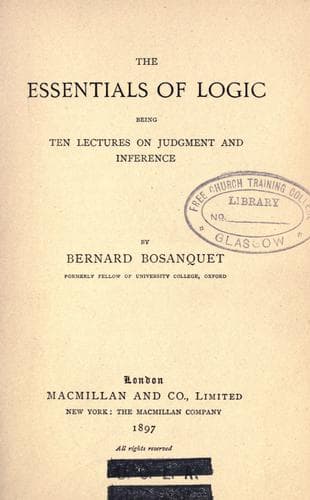
The Essentials of Logic, Being Ten Lectures on Judgment and InferenceBosanquet, Bernard
Philosophy
The Essentials of Logic, Being Ten Lectures on Judgment and Inference
Bosanquet, Bernard
Logic
In order to make this distinction clear, let us consider the
proposition as it reaches us from without, that is to say, either as
spoken or as written. The words, the parts of such a proposition, as we
hear or read them, are separate and successive either in time alone, or
in time and space. Further, the mere sounds or signs can be mastered
apart from the meaning. You can repeat them or copy them without
understanding them in the least, as _e.g._ in the case of a proposition
in an unknown language. So far, the proposition has not become a
judgment, and I do not suppose that any logician would admit that it
deserved the name even of a proposition. But if not, then we must not
confuse the attributes which it has before it becomes a proposition
with those which it has after.
{83} Further, in understanding a proposition, or in construing a
sentence into a proposition (if the sentence only becomes a proposition
when understood), there are many degrees. I read upon a postcard,
“A meeting will be held on Saturday next by the Women’s Liberal
Association, to discuss the taxation of ground-rents.” The meaning of
such a sentence takes time to grasp, and if the words are read aloud
to us, must of necessity be apprehended by degrees. We understand very
quickly that a meeting is to be held next Saturday. This understanding
is already a judgment. It is something quite different from merely
repeating the words which we read. It consists in realising them as
meanings, and bringing these meanings together into a connected idea,
and affirming this idea to belong to our real world. The meanings are
not separate, outside one another, as the words are when we first
hear or read them. They enter into each other, modify each other, and
become parts of an ideal whole. This gradual apprehension of a sentence
recalls to one the boyish amusement of melting down bits of lead in a
ladle. At first the pieces all lie about, rigid and out of contact; but
as they begin to be fused a fluid system is formed in which they give
up their rigidity and independence, and enter into the closest possible
contact, so that their movements and position determine each other. But
still some parts, like words not yet grasped, remain hard and separate,
and it is only when the melting is complete that this isolation is
destroyed, and there are no longer detached fragments, but a fluid body
such that all its parts are in the closest connection with one another.
Public-domain text, read in full here on John Shaqi.
Reviews
Reviews
No reviews yet
Be the first to share your thoughts on this work.
Join the Discussion
Join the discussion
Sign in to leave a comment or review.
Sign InorCreate an account