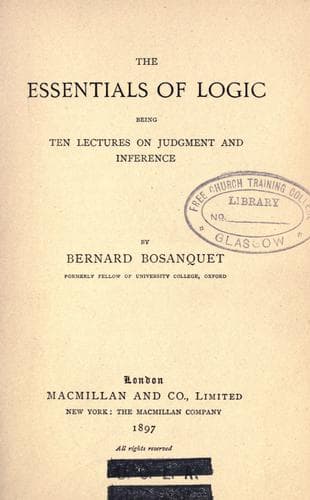
The Essentials of Logic, Being Ten Lectures on Judgment and InferenceBosanquet, Bernard
Philosophy
The Essentials of Logic, Being Ten Lectures on Judgment and Inference
Bosanquet, Bernard
Logic
4. Thus we must be very careful how we apply the conception of
“parts of speech.” The grammatical analysis which classifies words
as substantives, adjectives, adverbs, verbs, and the like, is not to
be taken as telling us what words are by themselves, but just the
opposite, viz. what they do when employed in a significant sentence.
They are studied separately for convenience in attending to them, as
we may study the wheels and pistons of an engine; but the work which
gives them their names can only be done when they are together. This
truth is often expressed by saying that “the sentence is the unit
of language,” _i.e._ a word taken by itself cannot have a complete
meaning--unless it is a verb, or used with verbal force, for a verb
is an unanalysed sentence. If any one uses a substantive or adverb by
itself, we think that he has not finished his sentence, and no meaning
is conveyed to our minds. We ask him, “Well, what about it?” The same
is true, as we saw, of a relative clause. If we read in a newspaper
such a clause as this, “The epidemic of influenza, which has appeared
in England for three successive seasons,” followed by a full stop, we
should infer, without hesitation, that some words had dropped out by
accident. Of course such a {86} combination of words would make us
think something, but the meaning which we might ascribe to it would be
conjectural; we should necessarily complete the thought for ourselves
by some affirmation--some relation to reality--while recognising that
no such relation was given in the clause as we read it. Nothing less
than a sentence, or, omitting the wish and the command, nothing less
than a proposition, conveys a meaning in which the mind can acquiesce
as not requiring to be supplemented conjecturally. There are traces in
language that indicate the sentence to have been historically prior to
the word. I question whether the word could be certainly distinguished
within the sentence in early languages that have not been reduced
to writing. The tendency of reflective analysis, as in grammar and
dictionaries, is to give it a more and more, artificial isolation. The
Greeks did not separate their words in writing, and they wrote down
the change in a terminal consonant produced by the initial letter of
the next word, just as if it was within a compound word. Nor had they
really any current term co-extensive with our “word.” Where we should
say “the word ‘horse’” they most commonly use the neuter article
“the” followed by the word in question as if in quotation-marks (”the
‘horse’“). In defining noun and verb, Aristotle has no simple class
name like ”word“ to employ as a common element of the definition, but
uses the curious description ”a portion of discourse, of which no part
has a meaning by itself.“
Public-domain text, read in full here on John Shaqi.
Reviews
Reviews
No reviews yet
Be the first to share your thoughts on this work.
Elsewhere in the archive
Join the Discussion
Join the discussion
Sign in to leave a comment or review.
Sign InorCreate an account