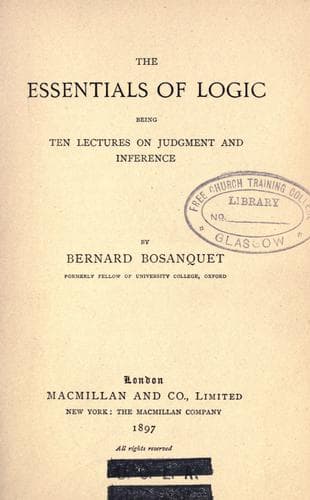
The Essentials of Logic, Being Ten Lectures on Judgment and InferenceBosanquet, Bernard
Philosophy
The Essentials of Logic, Being Ten Lectures on Judgment and Inference
Bosanquet, Bernard
Logic
Of course, single words often stand as signs for propositions. It
is interesting to note the pregnant meaning of a single word in the
mouth of a child. Thus “stool” was {87} used to mean “(1) Where is my
stool? (2) My stool is broken; (3) Lift me on to the stool; (4) Here
is a stool.” [1] There is in this an interesting conflict of form and
meaning, owing to the child of European race having at command only
“parts of speech.” In a less analytical language he might have at
command a sound corresponding to a sentence rather than to a “noun
substantive.”
[1] Preyer, quoted in _Höffding, Psych_., 176.
The verb of inflected languages, [1] such as Greek or Latin, in which
the “nominative case” need not be supplied even by a pronoun, is the
type for us of a sentence not yet broken up.
[1] In German and English, though the verb is inflected, custom
forbids it to stand without the pronoun.
The bearing of this truth on Logic is to make us treat it in two parts
and not in three. We do not treat of Name, Proposition, Syllogism, or
of Concept, Judgment, Inference, but only of the two latter parts. The
name or concept has no reality in living language or living thought,
except when referred to its place in a proposition or judgment. We
ought not to think of propositions as built up by putting words or
names together, but of words or names as distinguished though not
separable elements in propositions. Aristotle takes the simple and
straightforward view. “A term is the element into which a proposition
is broken up, such as subject and predicate.” [1] Of course different
languages separate the parts of the proposition very differently,
{88} and uneducated people hardly separate them at all. Formal Logic
breaks down the grammatical meaning of “name,” so far as to treat as a
“logical name” any complex words that can stand as Subject or Predicate
in a Proposition (_e.g._ a relative clause).
[1] _Anal. prior_., 24b, 16. The opposite view seems to be
expressed in the beginning of the περὶ Ἑρμενείας [= peri
Hermeneias, _de Interpretatione_], that the separate word
corresponds to the separate idea. I have attempted to explain
this as an illusion, p. 73, above.
_Denotation and Connotation_
Public-domain text, read in full here on John Shaqi.
Reviews
Reviews
No reviews yet
Be the first to share your thoughts on this work.
Elsewhere in the archive
Join the Discussion
Join the discussion
Sign in to leave a comment or review.
Sign InorCreate an account