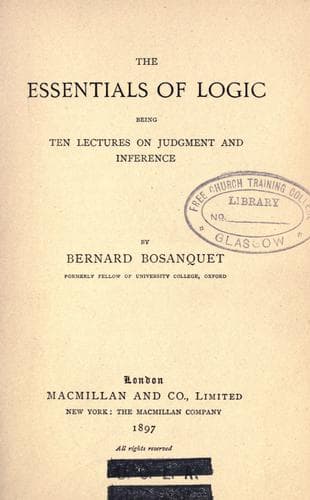
The Essentials of Logic, Being Ten Lectures on Judgment and InferenceBosanquet, Bernard
Philosophy
The Essentials of Logic, Being Ten Lectures on Judgment and Inference
Bosanquet, Bernard
Logic
5. The doctrine of the meaning of names has suffered from their
relation to propositions not being borne in mind. Mill’s discussion [1]
is very sensible, but, as always, very careless of strict system. More
especially it seems a pity to state the question as if it concerned
a division of names into Connotative and Non-connotative; because in
this way we from the first let go of the idea that the meaning of a
name has necessarily two aspects, [2] and we almost bind ourselves to
make out that there are some non-connotative names. It is better to
consider this latter subject on its merits. Mill says that an ordinary
significant name such as “man” “signifies the subjects directly, the
attributes indirectly; it _denotes_ the subjects, and implies or
involves or indicates, or, as we shall say henceforth, _connotes_, the
attributes.” In short, the denotation of a name consists of the things
_to which_ it _ap_plies, the connotation consists of the properties
which it _im_plies. The denotation is made up of individuals and
the connotation of attributes. Denotation is also called Extension,
especially if we are speaking of Concepts rather than of names.
Connotation is then called Intension. In the German writers it is
more usual to say that the Extension or Area (_Umfang_) consists not
of the individuals, but of the species that are contained in {89}
the meaning of a general name. They oppose it to Content (_Inhalt_)
corresponding to our “Connotation.” Thus the “Area” of “rose” would
not be the individual roses in the world, but rather all the species
of rose in the world (_Rosa Canina, Rosa Rubiginosa_, etc.). This
raises a difficulty as to the denotation of a specific name, but
perhaps represents the actual process of thought, in the case of a
generic name, better than that which Mill adopts. The difference is not
important.
[1] _Logic_, Bk. I. c. ii. § 5. Cf. Venn, 174 and 183, and Bain, 48.
[2] See Bradley, p. 155.
Well, then, according to Mill, when we say, “The Marshal Niel is a
yellow rose,” we refer directly to a group of real or possible objects,
and we mean that all these individual objects are yellow roses. The
attributes are only mentioned by the way, or implied. So Dr. Venn says
that the denotation is real, and the connotation is notional.
Public-domain text, read in full here on John Shaqi.
Reviews
Reviews
No reviews yet
Be the first to share your thoughts on this work.
Elsewhere in the archive
Join the Discussion
Join the discussion
Sign in to leave a comment or review.
Sign InorCreate an account