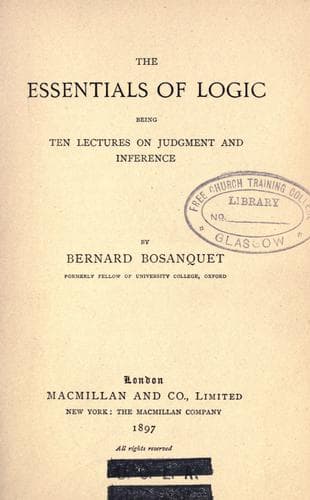
The Essentials of Logic, Being Ten Lectures on Judgment and InferenceBosanquet, Bernard
Philosophy
The Essentials of Logic, Being Ten Lectures on Judgment and Inference
Bosanquet, Bernard
Logic
But there is another side to this question. The objects may be _what
you mean_ but the attributes seem to be _the meaning_, for how can you
(especially on Mill’s theory of the proposition) refer to any objects
except through these attributes, unless indeed you can point to them
with your finger? And so again it seems, especially if we consider
Mill’s account of predication, as if the Connotation were the primary
meaning and the Denotation the secondary meaning. The Connotation
determines the Denotation; and if we “define” the meaning of the name
it is the Connotation that we state. And so Mill tells us two or
three pages further on, that whenever the names given to objects have
properly any meaning, the meaning resides not in what they denote, but
in what they connote. In short, {90} the denotation of a general name
is simply the meaning of its plural, or of its singular, in that sense
in which it implies a plural, while the connotation is the meaning _per
se_, not considered in its instances.
It is clear then that every name has these two kinds of meaning--first,
a content, and then instances, whether possible or actual, of the
content; and the two are obviously inseparable, although they are
distinguishable. Ultimately, indeed, the denotation itself is an
attribute, and so part of the connotation. It is one of the attributes
of man to be a unit in the plurality men, _i.e._ to be “a man.” It
may be said that some names have no plural. If so, these would be
non-denotative rather than non-connotative, but in fact this is not
true. The content of a significant name can always, unless hindered
by a special convention (see below on proper names), be _prima facie_
regarded, in respect of its actual embodiment, as a unit against
other possible units. Granting that there may be an object, which
according to our knowledge can only be real as an isolated case, the
very consideration of it as such a case is enough to distinguish its
existence, whether real or possible, from its content. Thus, as a real
or possible existence, the object is _ipso facto_ considered in the
light of a particular, and as capable of entering into a plurality.
But its nature or content, the meaning of its name, cannot enter
into a plurality. Two _meanings_, two connotations, are alternative
and irreconcilable. Denotation and connotation are thus simply the
particular, or particulars, which embody or are thought of as embodying
a content, and the single or universal content itself.
{91} _Have Proper Names Connotation?_
Public-domain text, read in full here on John Shaqi.
Reviews
Reviews
No reviews yet
Be the first to share your thoughts on this work.
Elsewhere in the archive
Join the Discussion
Join the discussion
Sign in to leave a comment or review.
Sign InorCreate an account