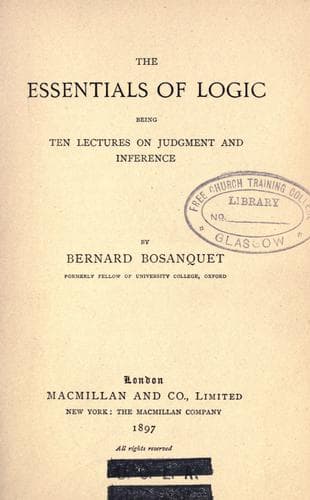
The Essentials of Logic, Being Ten Lectures on Judgment and InferenceBosanquet, Bernard
Philosophy
The Essentials of Logic, Being Ten Lectures on Judgment and Inference
Bosanquet, Bernard
Logic
6. Therefore I think that Mill is wrong, when he goes on, “The only
names of objects which connote nothing are Proper Names, and these
have, strictly speaking, no signification.” [1] If the name has no
signification, for what reason, or by what means, is it attached to a
person or a place? You may say that it is only a conventional mark. But
a mark which has power to select from all objects in the world, and
bring to our minds, a particular absent object, is surely a significant
mark. Granted that it is conventional, yet by what mechanism, and for
what purpose, does the convention operate?
[1] Cf. Venn, 183 ff, and Bradley, 156.
Mill’s point, however, is quite clear. To be told the name of a person
or object does not inform us of his or its attributes. Directly,
it only warns us by what sign the same person or object will be
recognisable in language again. [1] If a name is changed, the new name
tells us nothing different from the old, [2] whereas if an object that
was called vegetable is now called animal, our conception of it is
radically transformed. A name expresses the continued identity of an
object, and this implies only a historical continuity of attributes and
relations, and no constant attribute whatever.
[1] We cannot make it a distinctive mark of proper names that
they recur in different and quite disconnected meanings, because
the words which are used as general names have this same
property. Nor can we say that a proper name is not used in the
same sense of more than one object. Family names and national
names make this plainly untrue. Through these, and names
typically employed, there is a clear gradation from proper to
general names.
[2] The case of marriage may be urged. But a lady’s change of
name does not by itself indicate marriage. It is a mere fact,
which may have various explanations. The change of title (from
“Miss” to “Mrs.”) is more significant, but it is not a change of
name.
{92} Thus a _proper_ name is a contradiction in terms. [1] A name
should have a meaning. But a meaning cannot be proper--that is,
particular. The name-word is therefore like a demonstrative pronoun,
if this were attached, by a special convention, to one identifiable
object only. It acquires meaning, but its meaning is an ever-growing
contradiction with its usage. The meaning is necessarily general, the
usage is _ex hypothesi_ particular.
[1] So, from the complementary point of view, is a _general_
name. A name, it may be urged, _is_ meant to designate a
particular thing or things. And this a name with a true
“meaning” cannot do.
Public-domain text, read in full here on John Shaqi.
Reviews
Reviews
No reviews yet
Be the first to share your thoughts on this work.
Elsewhere in the archive
Join the Discussion
Join the discussion
Sign in to leave a comment or review.
Sign InorCreate an account