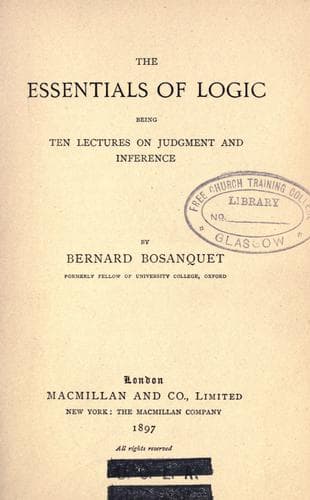
The Essentials of Logic, Being Ten Lectures on Judgment and InferenceBosanquet, Bernard
Philosophy
The Essentials of Logic, Being Ten Lectures on Judgment and Inference
Bosanquet, Bernard
Logic
This convention of usage, which prevents a proper name from becoming
general, _i.e._ from being cut loose and used simply for its meaning,
is always on the point of breaking down. [1] Christian names usually
indicate sex; family names, though now with little certainty, descent
and relationship. There are germs of a general meaning within the
several usages of names; while a Solon, a Croesus, a Christian, a
Mahometan, have become purely general names cut loose from all unique
reference. Still in a proper name, as such, we have no right to build
on any general meaning. Recognition is its only purpose; and the law
permits, it has been said, that a man should have one name for Mondays,
Wednesdays, and Fridays, and another for Tuesdays, Thursdays, and
Saturdays. The essence of a name is a reference to unique identity; it
employs meaning only to establish identity.
[1] See note on last page.
What kinds of things have proper names given, then? Always things
_individually_ known to the people who give {93} the name, and
interesting to them for some reason beyond generic or specific
qualities. Pet animals have names, when other animals of the same kind
have not. The peasants throughout England use names, it is said, for
all the fields, although strangers are not usually acquainted with them.
A Proper Name, then, has a connotation, but not a fixed general
connotation. It is attached to a unique individual, and connotes
whatever may be involved in his identity, or is instrumental in
bringing it before the mind.
When we think of history, the importance of proper names becomes
very great. This is the characteristic logical difference between
history and science. “England” and “France” are proper names, names
of individual existences in contact with our world of perception, not
scientific abstractions. Even the words, “1892 A.D.,” are partly of the
nature of a proper name. They say nothing merely general or abstract
about this year; they assign the year a name by counting forwards from
a unique point in the series of years, itself designated by the name
of a historical personage. Everything that is simply distinguished by
its place in the series of events in space and time is in some degree a
proper name. Thus we could not identify the French Revolution by mere
scientific definition. It is known by its proper name, as a unique
event, in a particular place and time. When thus identified it may have
all kinds of general ideas attached to it. It would be hard to show
that “Our earth,” “Our solar system” are not proper names, in virtue of
their uniqueness.
{94} _Inverse ratio of Connotation and Denotation_
Public-domain text, read in full here on John Shaqi.
Reviews
Reviews
No reviews yet
Be the first to share your thoughts on this work.
Elsewhere in the archive
Join the Discussion
Join the discussion
Sign in to leave a comment or review.
Sign InorCreate an account