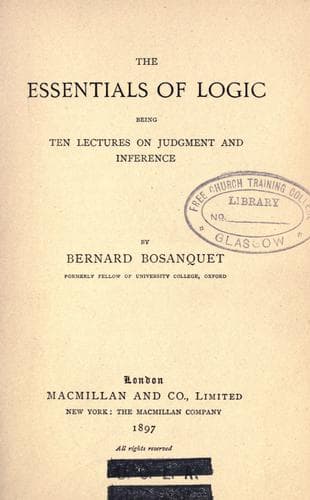
The Essentials of Logic, Being Ten Lectures on Judgment and InferenceBosanquet, Bernard
Philosophy
The Essentials of Logic, Being Ten Lectures on Judgment and Inference
Bosanquet, Bernard
Logic
7. It has sometimes been said that Connotation is in inverse ratio [1]
to Denotation. Mill explains the fact upon which any such idea
rests. [2] If we arrange things in classes, such that the one class
includes the other--_e.g. Species_ “Buttercup,” _Genus_ “Ranunculus,”
_Order_ “Ranunculaceae,”--of course the genus will contain many species
besides the one mentioned, and the order many genera besides the one
mentioned. The object of the arrangement is that they should do so, and
thus bring out the graduated natural affinities which prevail in the
world. Thus the denotation of the genus-name is larger than that [3] of
the species, and the denotation of the order-name is larger than that
of the genus-name.
[1] See Venn, p. 174, for reference to Hamilton. Venn points out
the fallacy.
[2] _Logic_, Bk. I. ch. vii. § 5.
[3] Or “than the species,” if we take the denotation as made up
of species.
But further, in such an arrangement the genus can contain only the
attributes which are common to all the species, and the order can
contain only the attributes which are common to all the genera; so the
genus-name implies fewer attributes (less connotation) than any one
species-name under it, and the order-name implies fewer attributes
(less connotation) than any one genus-name under it.
That is the fact which suggests the conception of Denotation and
Connotation as varying inversely.
But in any case it would not be right to speak thus mathematically of
an inverse ratio, because there is no meaning in a numerical comparison
of attributes and {95} individuals, and the addition of one attribute
will exclude sometimes more and sometimes fewer individuals. [1]
[1] See Jevons, p. 40.
Public-domain text, read in full here on John Shaqi.
Reviews
Reviews
No reviews yet
Be the first to share your thoughts on this work.
Elsewhere in the archive
Join the Discussion
Join the discussion
Sign in to leave a comment or review.
Sign InorCreate an account