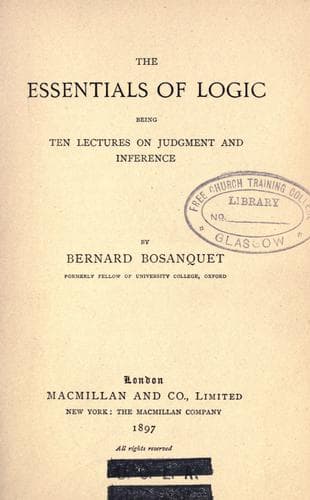
The Essentials of Logic, Being Ten Lectures on Judgment and InferenceBosanquet, Bernard
Philosophy
The Essentials of Logic, Being Ten Lectures on Judgment and Inference
Bosanquet, Bernard
Logic
And there are more important objections to the whole idea of a
corresponding gradation in these two kinds of meaning. The idea
of abstraction thus implied is altogether wrong. The meaning of a
genus-name does not _omit_ the properties in which the species differ.
If it did, it would omit nearly all properties. What happens is that
the genus-idea represents the general plan on which the species are
built, but provides for each of the parts that constitute the whole,
varying in the specific cases within certain limits. Thus in the
Ranunculaceae some species have no petals. But we do not omit the
character “petals” from the genus-idea. We state the general plan
so far as this element is concerned as “Petals five or more; rarely
none.” This is read by a botanist to mean that in some groups the
petals tend to be aborted, and sometimes are actually missing. In a
symbolic representation of the genus-idea such a property may stand as
A, and its various specific forms as A1, A2, A3, etc. There is nothing
to prevent these specific phases approaching and sometimes reaching
zero. No doubt if the classification is pursued in the direction of
“universals” containing fewer and fewer properties, it is possible
to arrive at concepts which appear to have a larger denotation and
a smaller connotation than those “below” them. “Ranunculaceae,”
“Dicotyledons,” “Plants,” “Organisms.”
But this is only because we choose to form our system by that
process of abstraction which consists in leaving out properties.
_E.g._ comparing Frenchmen with men in general, {96} we assume that
“Frenchman” indicates (_a_) all the qualities of humanity as such,
and (_b_) the qualities of French humanity in addition to these. But
is this so in fact? Humanity, considered as a wider, and therefore
as a deeper, idea, may have more content, as well as more area, than
Frenchmanity. We do not really, in thinking of humanity, omit from our
schematic thought all references to qualities of Greek, Jew, English,
and German, and their bearing and interaction upon one another. It is
only that we have been drilled to assume a certain neatness in the
pyramidal arrangement by which we vainly try to reduce the meaning of
a great idea to something that has no system and no inter-relation of
parts, but approaches as near as possible in fixity to the character
of a definite image, though far removed from such a character in the
impossibility of bringing it before the mind.
Public-domain text, read in full here on John Shaqi.
Reviews
Reviews
No reviews yet
Be the first to share your thoughts on this work.
Elsewhere in the archive
Join the Discussion
Join the discussion
Sign in to leave a comment or review.
Sign InorCreate an account