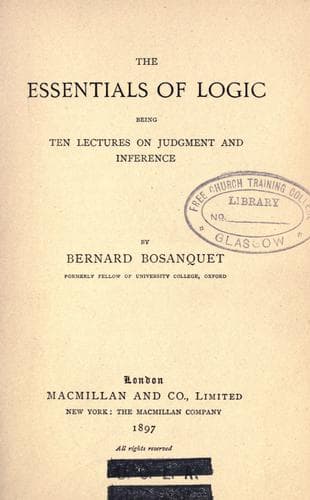
The Essentials of Logic, Being Ten Lectures on Judgment and InferenceBosanquet, Bernard
Philosophy
The Essentials of Logic, Being Ten Lectures on Judgment and Inference
Bosanquet, Bernard
Logic
So we can only say, “the greater the denotation the less the
connotation,” and “_vice versâ_”, in as far as we arrange ideas by
progressive abstraction in the sense of progressive omission. But
it is not the only way of regarding them. Things may develop new
inter-relations as their number increases. Has the community, as Mr.
Bradley asks, less meaning than the individual person? But we must not
consider the community, would be the answer; we must simply consider
the relation of an idea of one individual to any idea that applies
to many individuals. This is simply to rule out those relations that
arise within progressively larger wholes. We can do so, if we think the
exclusion necessary in the interests of logical purity, but it is only
by doing so that we can maintain the traditional view of connotation
and denotation. It is worth while to think out the {97} matter for
ourselves in relation to such familiar ideas as those of man and
animal. It is plain that the idea of “animal” cannot omit all reference
to intelligence, but must in some way allow for the different phases
of this property which run throughout the animal kingdom, and only
find a climax in man. And it is plain also, that even if intelligence
were wholly omitted, this would not leave behind, as in a simple
stratification, properties in which the whole animal kingdom was the
same. Man’s animality is modified throughout in a way corresponding
to his rationality, so that no general idea could be framed including
him and other animals, simply by collecting properties which are
the same and omitting those which are different. The idea of “man”
really becomes richer when considered in the light of a comparison
[1] with the rest of the animal world. Our great systems of natural
classification, representing affinities graduated by descent, are what
give the view which we have criticised a certain objective importance.
But they do not establish it as an exclusive logical doctrine.
[1] If we insist on throwing the whole of this comparison, in
explicit shape, into the complete idea of man, then the progress
to the idea “animal” can add nothing; even so, however, it loses
nothing, but simply becomes the same set of relations, looked
at, so to speak, from the other end.
{98}
LECTURE VI PARTS OF THE JUDGMENT, AND ITS UNITY
_Parts of the Judgment_
1. The result of taking the Judgment as one with the Proposition
has been to assume that its parts were the same as those of the
Proposition; [1] and moreover the same as those of the Proposition in a
very artificial form, viz. as analysed into three separable elements,
“Subject,” “Predicate,” “Copula,” commonly represented in the examples
of the text-books by Substantive, Adjective or Substantive, and the
Verb “is.”
Public-domain text, read in full here on John Shaqi.
Reviews
Reviews
No reviews yet
Be the first to share your thoughts on this work.
Elsewhere in the archive
Join the Discussion
Join the discussion
Sign in to leave a comment or review.
Sign InorCreate an account