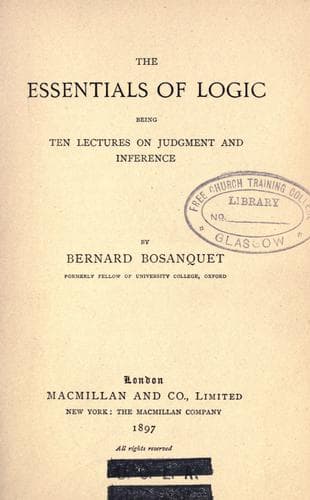
The Essentials of Logic, Being Ten Lectures on Judgment and InferenceBosanquet, Bernard
Philosophy
The Essentials of Logic, Being Ten Lectures on Judgment and Inference
Bosanquet, Bernard
Logic
(i.) In its simplest shape the notion of “two ideas” involves the
great blunder which I explained in Lecture IV. It suggests that the
parts of Judgment are separate and successive psychical states, and
that the Judgment consists in a change from the one to the other.
Herbert Spencer, as I understand him, considers every relation to be
apprehended as a mental change or passage from one idea to another.
This view would degrade logical connection into mere psychical
transition. I do not say that there is no psychical transition in
Judgment. I do say that psychical transition is not enough to make a
Judgment. The parts of Judgment, as we saw in the last lecture, do
not succeed one another separately like the parts of a sentence. The
relation between Subject and Predicate is not a relation between mental
states, but is itself the content of a single though continuous mental
state. Mill has rightly touched on this point. “When I say that fire
causes heat, do I mean that my idea of fire causes my idea of heat?”
[1] and so on. The fact is that “Fire-causing-heat” is itself the
single content or meaning represented in my symbolic idea; it is not a
succession of psychical states in my mind, or a passage from the idea
of fire to the idea of causing heat.
[1] _Logic_, Bk. I. ch. V. § I.
{103} _Absence of assertion_
(ii.) But further, understanding now that the Judgment is composed of
a single ideal content, and is not a transition from one mental state
to another, there is still a difficulty in the conception that its
component elements are nothing but ideas. If the Subject in Judgment is
no more than an ideal content, how, by what means, does the Judgment
claim to be true of Reality? “The Subject cannot belong to the content
or fall within it, for in that case it would be the idea attributed to
itself.” [1] If the Subject were only a part of an ideal content it
would not claim to be true of Reality, and where it _appears_ to be
only an ideal content there is much dispute in what sense the Judgment
does claim to be true of Reality. “Violations of a law of nature are
impossible.” “The three angles of a triangle are equal to two right
angles.” “All trespassers will be prosecuted.” In these Judgments we
should find it hard to make out that the Subjects are real things
corresponding to our ideas. And yet, if they are not, how can the
Judgment attach itself to Reality? This is the difficult question of
the distinction between the categorical and the hypothetical Judgment,
and we shall have to return to it. In the meantime, we must adhere to
our judgment of perception as the true underlying type. The Subject
is here not an idea, but is the given reality, _this_ or _that_, and
the Judgment is not a conjunction of two ideas, but is present reality
qualified by an idea. We say, “It is very hot,” meaning that heat, the
general quality embodied for us in an ideal content, is true of--forms
one tissue with--the surroundings which here and now press upon our
Public-domain text, read in full here on John Shaqi.
Reviews
Reviews
No reviews yet
Be the first to share your thoughts on this work.
Elsewhere in the archive
Join the Discussion
Join the discussion
Sign in to leave a comment or review.
Sign InorCreate an account