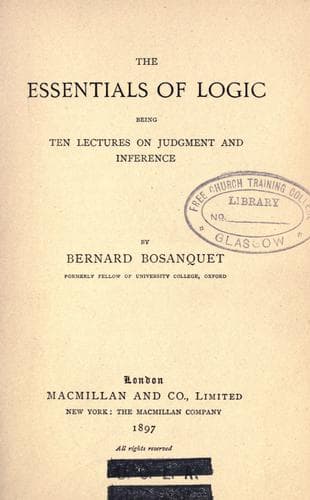
The Essentials of Logic, Being Ten Lectures on Judgment and InferenceBosanquet, Bernard
Philosophy
The Essentials of Logic, Being Ten Lectures on Judgment and Inference
Bosanquet, Bernard
Logic
attention. Or again, “This is red,” {104} _i.e._ the content of the
idea red is what my attention selects and emphasises within the mass
of detail presented to it in its own unique focus which the pronoun
“this” simply points out as though with the finger. We shall find such
a structure underlying all the more artificial forms of Judgment.
[1] _Bradley’s Principles of Logic_, p. 14.
_Two Things_
(_b_) Thus it would seem that Jevons and Mill are much nearer the real
point when they say that the proposition has to do with two Things,
or with a Thing and a group of Things. But we must notice in passing
that Mill, [1] after fighting hard against calling them Ideas, takes
our breath away by saying that they are states of consciousness. There
is, of course, a difficulty, which I will not try to deal with now, in
the fact that however much we _refer_ to things, we have nothing to
_work with intellectually_ but our ideas of them, and in some types
of Judgment the reference to real things is difficult to trace. Mill
further emphasises this by showing, that what we assert in ordinary
_general_ Judgment is co-existence of attributes. [2] “Now when we
say, Man is mortal, we mean that wherever these various mental and
physical phenomena (the attributes of man) are all found, then we have
assurance that the other physical and mental phenomenon called death,
will not fail to take place.” That is, no doubt, a very indirect way of
referring to the real things which we call men. Moreover, he treats all
conclusions in geometry and mechanics as hypothetical. [3] All this we
shall have to return to, in order to reconcile it with our doctrine;
which is apparently coincident with {105} Mill’s view in the place
first alluded to, that the subject in Judgment is always reality.
[1] _Logic_, Bk. I. ch. V. § 5. [2] _Ibid_., § 4.
[3] _Ibid_., Bk. II. ch. vi. §§ 3, 4.
Public-domain text, read in full here on John Shaqi.
Reviews
Reviews
No reviews yet
Be the first to share your thoughts on this work.
Elsewhere in the archive
Join the Discussion
Join the discussion
Sign in to leave a comment or review.
Sign InorCreate an account