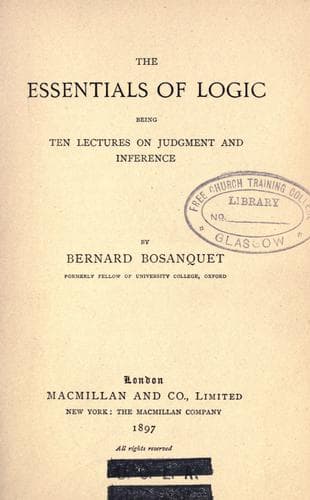
The Essentials of Logic, Being Ten Lectures on Judgment and InferenceBosanquet, Bernard
Philosophy
The Essentials of Logic, Being Ten Lectures on Judgment and Inference
Bosanquet, Bernard
Logic
Does this state a fact? I think it implies a fact much more distinctly
than the hypothetical does, but of course it is a question whether an
alternative can be called a fact. It seems a precise expression of
some kinds of reality, but it is not a solid single momentary fact.
It is very appropriate to the objects of philosophy as the higher
concrete science, which are conceived as systems of facts bearing
definite relations to each other; _e.g._ “Society is a structure of
individual characters, having positions which are not interchangeable.”
Taken all as a mass, they are conjunctively connected, but taken in
distinguishable relations they are disjunctively related. A human
being as such has some position and no other, and this is ultimately
determined by {125} the nature of the social whole to which he
belongs. He is if this, nothing else, and if nothing else, then this.
A more artificial example, which illustrates the degree in which
actual abstract knowledge and purpose can be embodied by man in
machinery, is the interlocking system of points and signals at a great
railway station. I suppose that the essence of such a system lies in
arrangements for necessarily closing every track to all but one at a
time of any tracks which cross it or converge into it. The track X
receives trains from A, B, C, D; if the entrance for those from A is
open, B, C, and D are _ipso facto_ closed; if A, B, and C are closed,
D is open, and so on. This is a disjunction consciously and purposely
incorporated in material fact, and differs from a Disjunctive Judgment
only in so far as existence necessarily differs from discursive thought.
The disjunction seems to complete the system of judgments, including
all the others in itself, and it is wrong in principle to distinguish,
_e.g._ between a hypothetical and categorical disjunction, or to
consider how a disjunction can be denied. For disjunction in itself
implies a kind of individuality which is beyond mere fact and mere
abstract truth, though allied to both; and all intelligible negation
is under, not of, a disjunction. Negation of a disjunction would
mean throwing aside the whole of some definite group of thoughts as
fallacious, and going back to begin again with a judgment of the
simplest kind. It amounts to saying, “None of your distinctions touch
the point; you must begin afresh.”
{126}
LECTURE VIII NEGATION, AND OPPOSITION OF JUDGMENTS
_Distinction between Contrary and Contradictory opposition_ [1]
1. The only important point in the traditional diagram of opposition
of Judgments is the distinction between contrary and contradictory
opposition, the opposition, that is, between A and E, and the
opposition between A and O, or E and I.
[1] Read Bain, pp. 55-6, on “Negative Names and the Universe
of the Proposition,” also on “Negative Propositions,” p. 83
ff.; Venn, _Empirical Logic_, pp. 214--217; Jevons, _Elementary
Logic_, ix., on “Opposition of Propositions”; Mill, ch. iv. § 2.
Public-domain text, read in full here on John Shaqi.
Reviews
Reviews
No reviews yet
Be the first to share your thoughts on this work.
Elsewhere in the archive
Join the Discussion
Join the discussion
Sign in to leave a comment or review.
Sign InorCreate an account