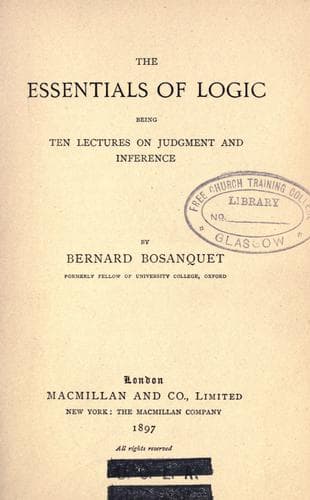
The Essentials of Logic, Being Ten Lectures on Judgment and InferenceBosanquet, Bernard
Philosophy
The Essentials of Logic, Being Ten Lectures on Judgment and Inference
Bosanquet, Bernard
Logic
Here, then, is the clue to the analysis of _all Abstract Judgments_,
Like Perceptive Judgment, they affirm something of Reality, but they
do this indirectly and not directly. {123} Underlying them there is
the implied Categorical Judgment, “Reality has a character, such
that, supposing so and so, the consequence will be so and so.” And
if this implied assertion is true, then the Hypothetical Judgment is
true, although its terms may be not only unreal, but impossible. “If
a microscopic object-lens with a focal length of 1/100 in. were used,
its magnifying power with an A eye-piece would be so many diameters.”
This is a mere matter of calculation, and is unquestionably true,
depending upon the effects of refraction upon the optical image. But I
do not suppose that such an object-lens could be made, or used. Does
such a Judgment, although true, express a _fact_? No, I should say not,
although common usage varies. I remember a _Pall Mall_ leading article
which said, “It is an absolute fact, that, if Mr. Gladstone had not
done something--the Government would have committed--some iniquity
or other.” Is this what we call a fact? We observe that the content
actually mentioned was never real at all. The implied connection
with reality is “There existed in reality a condition of things
(unspecified) in which _if_ Mr. Gladstone, etc., etc.” Are mathematical
truths facts, and in what sense? Abstract truth need not, and perhaps
cannot express fact, but implies fact indirectly.
_Disjunctive Judgment_
(5) The Disjunctive Judgment “A is either B or C,” is again not
a judgment of doubt but a mode of Knowledge, It may be taken as
numerical; then it gives rise to the statement of Chances. But in its
perfect form it is appropriate to the exposition of a content as a
system, and it may be taken as returning to the Categorical Judgment,
and combining it with the Hypothetical, because its {124} content is
naturally taken as an individual, being necessarily concrete.
The peculiar point of the Disjunctive is that it makes negation
positively significant.
“This signal light shows either red or green.” Here we have the
categorical element, “This signal light shows some colour,” and on the
top of this the two Hypothetical Judgments, “If it shows red it does
not show green,” “If it does not show red it does show green.” You
cannot make it up out of the two Hypothetical Judgments alone; they do
not give you the assertion that “it shows some colour.” [1]
[1] The example in the text, chosen for its simplicity, may
be objected to as involving perceptive concreteness by the
pronoun “this.” You can have a disjunction, it may be said,
dealing with “the triangle” as such; and why should this be
more “Categorical” than the assertion that the triangle has
its angles = three right angles? Still, it might be replied,
the development of a single nature into a number of precise
and necessary alternatives, always gives it an implication of
self-completeness.
Public-domain text, read in full here on John Shaqi.
Reviews
Reviews
No reviews yet
Be the first to share your thoughts on this work.
Elsewhere in the archive
Join the Discussion
Join the discussion
Sign in to leave a comment or review.
Sign InorCreate an account