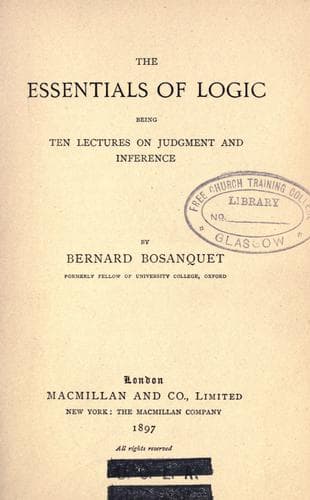
The Essentials of Logic, Being Ten Lectures on Judgment and InferenceBosanquet, Bernard
Philosophy
The Essentials of Logic, Being Ten Lectures on Judgment and Inference
Bosanquet, Bernard
Logic
_Contrary Negation_
2. Thus, Contrary Negation in its essence is affirmation with a
negative intention, and we may take as a type of it in this wider
sense the affirmation of a positive character with the intention of
denying another positive character. _E.g._ when you deny “This is a
right-angled triangle” by asserting “This is an equilateral triangle,”
you have typical contrary negation. It is not really safe to speak of
contraries except with reference to _judgments_, intended to deny each
{129} other; but it is common to speak of species of the same genus as
contraries or opposites, because the same thing cannot be both. [1]
[1] Bain, p. 55 ff.
We must therefore distinguish _contrary_ from _different_. Of course
the same thing or content has many different qualities, and even
combines qualities that we are apt to call contrary or opposite. But
as Plato was fond of pointing out, a thing cannot have different or
opposing qualities in the same relation, that is to say, belonging to
the same subject under the same condition. The same thing may be blue
in one part of it and green in another, and the same part of it may be
blue by daylight and green by candlelight. But the same surface cannot
be blue and green at once by the same light to the same eye looking in
the same direction. _Different_ qualities become _contrary_ when they
claim to stand in the same relation to the same subject. Right-angled
triangles and equilateral triangles do not deny each other if we leave
them in peace side by side. They are then merely different species of
the same genus, or different combinations of the same angular space.
But if you say, “This triangle is right-angled,” and I say “It is
equilateral,” then they deny each other, and become true contraries.
Then the _meaning_ of denial is always of the nature of _contrary_
denial. As we always speak and think within a general subject or
universe of discourse, it follows that every denial substitutes some
affirmation for the judgment which it denies. The only judgments in
which this is not the case are those called by an unmeaning tradition
Infinite Judgments, _i.e._ judgments in which the negative predicate
{130} includes every determination which has applicability to the
Subject. This is because the attribute denied has no applicability
to the Subject, and therefore all that has applicability is
undiscriminatingly affirmed, in other words, the judgment has no
meaning. “Virtue is not-square.” This suggests no definite positive
quality applicable to virtue, and therefore is idle. You may safely
analyse a significant negative judgment, “A is not B” as = “A is not B
but C,” or as = “A is X, which excludes B.” For X may be undetermined,
“a colour not red.” But then if the meaning is always affirmative or
positive, why do we ever use the negative form?
_Why use Negation?_
Public-domain text, read in full here on John Shaqi.
Reviews
Reviews
No reviews yet
Be the first to share your thoughts on this work.
Elsewhere in the archive
Join the Discussion
Join the discussion
Sign in to leave a comment or review.
Sign InorCreate an account