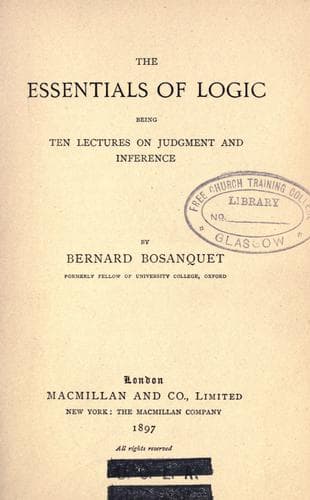
The Essentials of Logic, Being Ten Lectures on Judgment and InferenceBosanquet, Bernard
Philosophy
The Essentials of Logic, Being Ten Lectures on Judgment and Inference
Bosanquet, Bernard
Logic
3. In the first place, we use it because it indicates exclusion,
and without it we cannot distinguish between mere differents on the
one hand and contraries on the other. If you ask me, “Are you going
to Victoria, London Chatham and Dover station?” and I answer, “I am
going to Victoria, London Brighton and South Coast,” that will not be
satisfactory to you, unless you happen to know beforehand that these
stations are so arranged that if you are at one you are not at the
other. They might be a single station used by different companies, and
called indifferently by the name of either. To make it clear that the
suggestion and the answer are incompatible, I must say, “I am _not_
going to Victoria, London Chatham and Dover,” and I may add or not add,
“I _am_ going to Victoria, London Brighton and South Coast.” That tells
you that the one predicate excludes the other, and that is the first
reason why we use the generalised form of exclusion, _i.e._ negation.
But in the second place, it can give us more, and something absolutely
necessary to our knowledge, and that is not {131} merely exclusion, but
exhaustion. In literal form negation is absolutely exhaustive, that is
to say, contradictory. The Judgment “A is not B” forms an exhaustive
alternative to the Judgment “A is B,” so that no third case beyond
these two is possible, and therefore you can argue from the falsehood
of either to the truth of the other. Now this form is potentially of
immense value for knowledge, and all disjunction consists in applying
it; but as it stands in the abstract it is worthless, because it is
an empty form. “A is red or not-red.” If either of these is false the
other is true. But what do you gain by this? You are not entitled to
put any positive meaning upon not-red; if you do so you slide into mere
contrary negation, and the inference from falsehood becomes a fallacy.
Make an argument, “The soul is red or not-red.” “It is not-red ∴ it is
some other colour than red.” The argument is futile. We have construed
“not-red” as a positive contrary, and that being so, the disjunction is
no longer exhaustive. We had no right to say that the soul is either
red or some other colour; the law of Excluded Middle does not warrant
that.
Public-domain text, read in full here on John Shaqi.
Reviews
Reviews
No reviews yet
Be the first to share your thoughts on this work.
Elsewhere in the archive
Join the Discussion
Join the discussion
Sign in to leave a comment or review.
Sign InorCreate an account