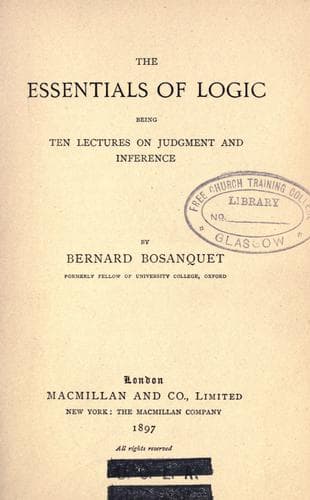
The Essentials of Logic, Being Ten Lectures on Judgment and InferenceBosanquet, Bernard
Philosophy
The Essentials of Logic, Being Ten Lectures on Judgment and Inference
Bosanquet, Bernard
Logic
But in this case was there really an inference? Does not the conclusion
fall inside the premisses? It must in one sense fall inside the
premisses, or it is not true. But it does not fall inside them until we
have brought them into contact by their point of identity and melted
them down into the same judgment. I admit that these inferences from
individual identity, assuming the terms not to be ambiguous, are only
just within the line of rational inference, but, as we see in this
case, they bring together the parts of a very extended universal. What
_is_ the lower limit of inference?
_Immediate Inference_
4. In the doctrine of _immediate Inference_ common Logic treats of
Conversion and the Opposition of judgments.
Is a mere transposition of Subject and Predicate, where the truth
of the new judgment follows from that of the old, an inference? It
is a matter of degree. [1] Does it give anything new? “The Queen
is a woman.” “A woman is the Queen.” If we make a real difference
between the implications of a Subject and a Predicate, we seem to get
something new; but it is a point of little interest. {142} Comparison
or Recognition are more like immediate inferences. Comparison means
that we do not let ourselves perceive freely, but take a particular
content as the means of apperception of another content, _i.e._ as
the medium through which we look at it. I do not merely look at the
second, but I look at it with the first in my mind. And so far I may
be said to infer, without the form of proof, from data of perception
to a relation between them. “You are taller than me,” is a result
obtained by considering your height from the point of view of mine, or
_vice versâ_. Recognition is somewhat similar. It is more than a mere
perception, because it implies reproduction of elements not given,
and an identification with them. I recognise this man _as_ so-and-so,
_i.e._ I see he is identical with the person who did so-and-so. It is
a judgment, but it goes beyond the primary judgment, “He is such and
such,” and is really inferred from it. It is a matter of degree. Almost
every Judgment can be broken up into elements, and recognition fades
gradually into cognition--we “recognise” an example of a law, a right,
a duty, an authority; not that we knew _it_, the special case, before,
but that in analysing it we find a principle which commands our assent,
and with which we identify the particular instance before us.
[1] The collective or general judgment, as commonly explained,
cannot be converted “simply,” because the predicate is “wider”
than the subject, and the same rule is accepted for the relation
of consequent to antecedent. The aim of science, it might almost
be said, is to get beyond the kind of judgment to which this
rule applies.
_Number of Instances_
Public-domain text, read in full here on John Shaqi.
Reviews
Reviews
No reviews yet
Be the first to share your thoughts on this work.
Elsewhere in the archive
Join the Discussion
Join the discussion
Sign in to leave a comment or review.
Sign InorCreate an account