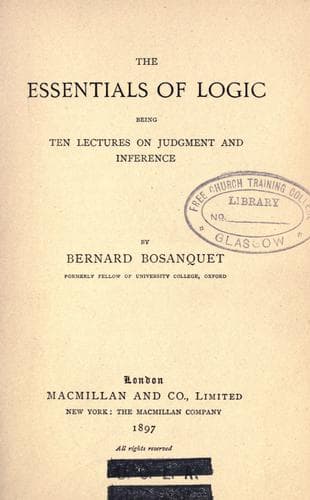
The Essentials of Logic, Being Ten Lectures on Judgment and InferenceBosanquet, Bernard
Philosophy
The Essentials of Logic, Being Ten Lectures on Judgment and Inference
Bosanquet, Bernard
Logic
Take the simplest conceivable case, which hardly amounts to Inference,
that of producing a given straight line. How is it that this is
possible? Because the direction of the straight line is universal and
self-identical as against possible directions in space, and it acts as
a rule which carries you beyond the given portion of it. This might
fairly be called an “immediate inference.” So I presume that any curve
can be constructed out of a sufficient portion of the curve, although,
except with a circle, this is more than repeating the same line over
again. The content has a nature which {140} is capable of prescribing
its own continuation. A curve is not a direction; a truth which is a
puzzle to the non-mathematician--it is a law of continuous change of
direction.
_System the ultimate condition of Inference_
3. _Ultimately_ the condition of inference is always a system. And
it will help us in getting a vital notion of inference if we think,
to begin with, of the interdependence of relations in space--in
geometrical figures, or, to take a commonplace example, in the
adjustment of a Chinese puzzle or a dissected map. Or any of the
propositions about the properties of triangles are a good example.
How can one property or attribute determine another, so that you can
say, “Given this, there must be that”? This can only be answered by
pointing to the nature of a whole with parts, or a system, which just
means this, a group of relations or properties or things so held
together by a common nature that you can judge from some of them what
the others must be. Not all systems admit of precise calculation and
demonstration, but wherever there is inference at all there is at
least an identity of content which may be more or less developed into
a precise relation between parts. For example, we cannot construct
geometrically the life and character of an individual man; we can argue
from his character to some extent, but the connection of facts in his
personal identity is all that we can infer for certain; and even this
involves a certain context of facts, as in circumstantial evidence.
Yet this simplest linking together of occurrences by personal identity
is enough to give very startling inferences. Thackeray’s story of the
priest is a good instance of inference from mere identity. “An old
abbé, talking among a party of intimate friends, happened {141} to say,
‘A priest has strange experiences; why, ladies, my first penitent was
a murderer.’ Upon this, the principal nobleman of the neighbourhood
enters the room. ‘Ah, Abbé, here you are; do you know, ladies, I was
the Abbé’s first penitent, and I promise you my confession astonished
him!’” Here the inference depends solely on individual identity, which
is, as we saw, a kind of universal.
Public-domain text, read in full here on John Shaqi.
Reviews
Reviews
No reviews yet
Be the first to share your thoughts on this work.
Elsewhere in the archive
Join the Discussion
Join the discussion
Sign in to leave a comment or review.
Sign InorCreate an account