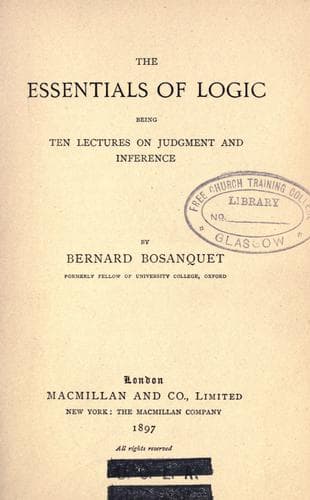
The Essentials of Logic, Being Ten Lectures on Judgment and InferenceBosanquet, Bernard
Philosophy
The Essentials of Logic, Being Ten Lectures on Judgment and Inference
Bosanquet, Bernard
Logic
Now this very important operation of number of examples, in helping the
mind to an explanation, is always being confused with the effect of
mere repetition of examples, which does not help you to an explanation,
_i.e._ a repetition in which one tells you no more than another.
But these mere repetitions operate _prima facie_ in a different
way, viz. by making you think there is an _unknown_ cause in favour
of the combination of properties which recurs, and lead up to the
old-fashioned perfect Induction and the doctrine of chances, and not to
demonstration. [1]
[1] Ultimately the calculus of chances may be said to rest on
the same principle as Induction, in so far as the repetition of
examples derives its force from the (unspecified) variety of
contexts through which this repetition shows a certain result
to be persistent. But in such a calculus the presumption from
recurrence in such a variety of contexts is only estimated, and
not analysed.
On the road from guess-work to demonstration, and generally assisted
by great experience, we have _skilful_ {145} guess-work, the first
stage of discovery. This depends on the capacity for hitting upon
qualities which _are_ connected by causation, though the connection
remains to be proved. So a countryman or a sailor gets to judge of
the weather; it is not merely that he has seen so many instances, but
he has been taught by a great variety of instances to recognise the
essential points, and has formed probably a much more complex judgment
than he can put into words. So again a doctor or a nurse can see how
ill a patient is, though it does not follow that they could always say
why this appearance goes with this degree of illness. In proportion
as you merely _presume_ a causal connection, it is guess-work or pure
discovery. In as far as you can _analyse_ a causal connection it is
demonstration or proof; and for Logic, discovery cannot be treated
apart from proof, except as skilful guess-work. _In as far as_ there
is ground for the guess, so far it approaches to proof; _in as far as_
there is no ground, it gives nothing for Logic to get hold of--is mere
caprice. A good scientific guess really depends on a shrewd eye for the
essential points. I am not mathematician enough to give the history
of the discovery of Neptune by Leverrier and Adams, “calculating a
planet into existence by enormous heaps of algebra,” [1] but it must
have begun as a guess, I should suppose it was suggested before Adams
and Leverrier took it up, on the ground of the anomalous movements of
Uranus indicating an attraction unaccounted for by the known solar
system. And I suppose that this guess would gradually grow into
demonstration as it became clear that nothing but a new planet would
explain the anomalies of {146} the orbit of Uranus. And at last the
calculators were able to tell the telescopist almost exactly where
to look for the unknown planet. The proof in this case preceded the
Public-domain text, read in full here on John Shaqi.
Reviews
Reviews
No reviews yet
Be the first to share your thoughts on this work.
Elsewhere in the archive
Join the Discussion
Join the discussion
Sign in to leave a comment or review.
Sign InorCreate an account