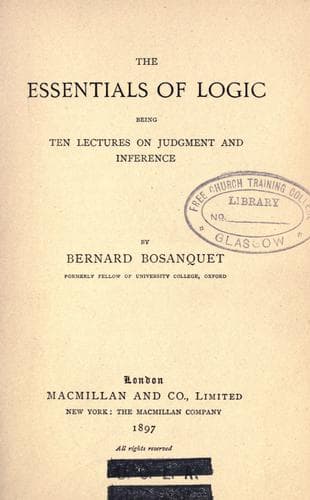
The Essentials of Logic, Being Ten Lectures on Judgment and InferenceBosanquet, Bernard
Philosophy
The Essentials of Logic, Being Ten Lectures on Judgment and Inference
Bosanquet, Bernard
Logic
observation or discovery by perception, and this makes it a very
dramatic example; but if the observation had come earlier, it would not
I suppose have dispensed with the precise proof of Neptune’s effect on
Uranus, though it might have made it easier.
[1] De Morgan, _Budget of Paradoxes_, p. 53.
_Figures of Syllogism_
6. In illustration of this progress from guess-work to science, [1]
I will give an example of the three Aristotelian figures of the
Syllogism. I omit the fourth. I assume that the heavier term, or the
term most like a “thing,” is fitted to be the Subject, and the term
more like an attribute to be the Predicate. The syllogistic rules
depend practically on the fact that common Logic, following common
speech and thought, treats the Predicate as wider than the Subject,
which corresponds to Mill’s view (also the common scientific view),
that the same effect may have several alternative causes (not a
compound cause, but different possible causes), and that consequent
is wider than antecedent. [2] It is this assumption that prevents
affirmative propositions from being simply convertible, _i.e._ prevents
“All men are mortal” from being identical with “All mortals are men,”
and but for it there would be no difference of figure at all, as there
is not for inference by equation.
[1] Cf. Plato’s _Republic_, Bk. VI., end. [2] See p. 141, note.
This progression is here merely meant to illustrate the universal or
systematic connection of particulars in process of disengaging itself.
But I do _not_ say that the first {147} figure with a major premise is
a natural form for all arguments.
I take the scheme of the first three figures from Jevons, and suggest
their meaning as follows:--
X denotes the major term.
Y denotes the middle term.
Z denotes the minor term.
1st Fig. 2nd Fig. 3rd Fig.
Major Premise YX XY YX
Minor Premise ZY ZY YZ
Conclusion ZX ZX ZX
Fig. 3. _An observation and a guess._
Yesterday it rained in the evening.
All yesterday the smoke tended to sink.
∴ The smoke sinking ( may be ) a sign of rain.
( is sometimes )
The conclusion cannot be general in this figure, because nothing
general has been said in the premisses about the subject of the
conclusion. So it is very suitable for a mere suggested connection
given in a single content--that of the time “yesterday,” implying
moreover that both the points in question have something to do with the
state of the atmosphere on that single day.
Fig. 2. _A tentative justification_.
Smoke that goes downwards is heavier than air
Particles of moisture are heavier than air.
∴ Particles of moisture may be in the descending smoke.
Public-domain text, read in full here on John Shaqi.
Reviews
Reviews
No reviews yet
Be the first to share your thoughts on this work.
Elsewhere in the archive
Join the Discussion
Join the discussion
Sign in to leave a comment or review.
Sign InorCreate an account