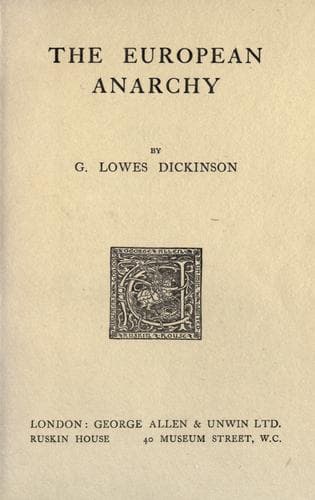
The European AnarchyDickinson, G. Lowes (Goldsworthy Lowes)
History
The European Anarchy
Dickinson, G. Lowes (Goldsworthy Lowes)
Europe -- Politics and government; World War, 1914-1918 -- Causes
THE EUROPEAN ANARCHY
By G. Lowes Dickinson
1916
CONTENTS
1. INTRODUCTION
Europe since the Fifteenth Century--Machiavellianism--Empire and the
Balance of Power
2. THE TRIPLE ALLIANCE AND THE ENTENTE
Belgian Dispatches of 1905-14.
3. GREAT BRITAIN
The Policy of Great Britain--Essentially an Overseas Power
4. FRANCE
The Policy of France since 1870--Peace and Imperialism--Conflicting
Elements
5. RUSSIA
The Policy of Russia--Especially towards Austria
6. AUSTRIA-HUNGARY
The Policy of Austria-Hungary--Especially towards the Balkans
7. GERMANY
The Policy of Germany--From 1866 to the Decade 1890-1900--A Change
8. OPINION IN GERMANY
German "Romanticism"--New Ambitions.
9. OPINION ABOUT GERMANY
Bourdon--Beyens--Cambon--Summary
10. GERMAN POLICY FROM THE DECADE 1890-1900
Relation to Great Britain--The Navy.
11. VAIN ATTEMPTS AT HARMONY
Great Britain's Efforts for Arbitration--Mutual Suspicion
12. EUROPE SINCE THE DECADE 1890-1900
13. GERMANY AND TURKEY
The Bagdad Railway
14. AUSTRIA AND THE BALKANS
15. MOROCCO
16. THE LAST YEARS
Before the War--The Outbreak of War
17. THE RESPONSIBILITY AND THE MORAL
The Pursuit of Power and Wealth
18. THE SETTLEMENT
19. THE CHANGE NEEDED
Change of Outlook and Change of System--An International
League--International Law and Control
THE EUROPEAN ANARCHY
1. _Introduction_.
In the great and tragic history of Europe there is a turning-point that
marks the defeat of the ideal of a world-order and the definite acceptance
of international anarchy. That turning-point is the emergence of the
sovereign State at the end of the fifteenth century. And it is symbolical
of all that was to follow that at that point stands, looking down the
vista of the centuries, the brilliant and sinister figure of Machiavelli.
From that date onwards international policy has meant Machiavellianism.
Sometimes the masters of the craft, like Catherine de Medici or Napoleon,
have avowed it; sometimes, like Frederick the Great, they have disclaimed
it. But always they have practised it. They could not, indeed, practise
anything else. For it is as true of an aggregation of States as of an
aggregation of individuals that, whatever moral sentiments may prevail, if
there is no common law and no common force the best intentions will be
defeated by lack of confidence and security. Mutual fear and mutual
suspicion, aggression masquerading as defence and defence masquerading as
aggression, will be the protagonists in the bloody drama; and there will
be, what Hobbes truly asserted to be the essence of such a situation, a
chronic state of war, open or veiled. For peace itself will be a latent
war; and the more the States arm to prevent a conflict the more certainly
will it be provoked, since to one or another it will always seem a better
chance to have it now than to have it on worse conditions later. Some
Public-domain text, read in full here on John Shaqi.
Reviews
Reviews
No reviews yet
Be the first to share your thoughts on this work.
Join the Discussion
Join the discussion
Sign in to leave a comment or review.
Sign InorCreate an account