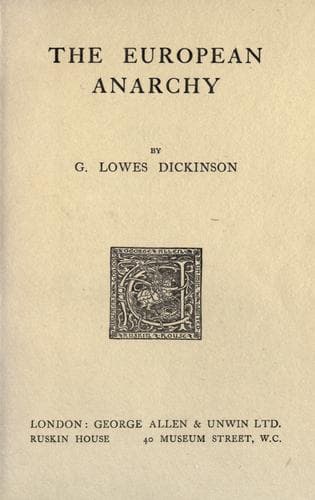
The European AnarchyDickinson, G. Lowes (Goldsworthy Lowes)
History
The European Anarchy
Dickinson, G. Lowes (Goldsworthy Lowes)
Europe -- Politics and government; World War, 1914-1918 -- Causes
In Germany, as elsewhere, both in home and foreign affairs, there was an
intense and unceasing conflict of competing forces and ideas. In Germany,
as elsewhere, policy must have adapted itself to circumstances, different
personalities must have given it different directions at different times.
We have not the information at our disposal which would enable us to trace
in detail the devious course of diplomacy in any of the countries of
Europe. What we know something about is the general situation, and the
action, in fact, taken at certain moments. The rest must be, for the
present, mainly matter of conjecture. With this word of caution, let
us now proceed to examine the policy of Germany.
The general situation we have already indicated. We have shown how the
armed peace, which is the chronic malady of Europe, had assumed during the
ten years from 1904 to 1914 that specially dangerous form which grouped the
Great Powers in two opposite camps--the Triple Alliance and the Triple
Entente. We have seen, in the case of Great Britain, France, Russia, and
Austria-Hungary, how they came to take their places in that constellation.
We have now to put Germany in its setting in the picture.
Germany, then, in the first place, like the other Powers, had occasion
to anticipate war. It might be made from the West, on the question of
Alsace-Lorraine; it might be made from the East, on the question of the
Balkans. In either case, the system of alliances was likely to bring into
play other States than those immediately involved, and the German Powers
might find themselves attacked on all fronts, while they knew in the
latter years that they could not count upon the support of Italy.
A reasonable prudence, if nothing else, must keep Germany armed and
apprehensive. But besides the maintenance of what she had, Germany was
now ambitious to secure her share of "world-power." Let us examine in
what spirit and by what acts she endeavoured to make her claim good.
First, what was the tone of public opinion in Germany during these
critical years?
[Footnote 1: Emile Ollivier, "L'Empire Libéral."]
8. _Opinion in Germany_.
Public-domain text, read in full here on John Shaqi.
Reviews
Reviews
No reviews yet
Be the first to share your thoughts on this work.
Join the Discussion
Join the discussion
Sign in to leave a comment or review.
Sign InorCreate an account