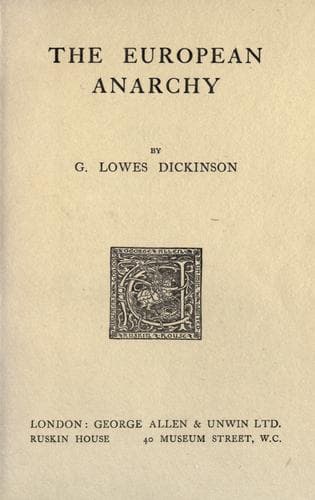
The European AnarchyDickinson, G. Lowes (Goldsworthy Lowes)
History
The European Anarchy
Dickinson, G. Lowes (Goldsworthy Lowes)
Europe -- Politics and government; World War, 1914-1918 -- Causes
Call it an alliance, _entente_, or what you will, the grouping of the
Powers arranged by the personal intervention of the King of England
exists, and if it is not a direct and immediate threat of war against
Germany (it would be too much to say that it was that), it constitutes
none the less a diminution of her security. The necessary pacifist
declarations, which, no doubt, will be repeated at Reval, signify very
little, emanating as they do from three Powers which, like Russia and
England, have just carried through successfully, without any motive
except the desire for aggrandizement, and without even a plausible
pretext, wars of conquest in Manchuria and the Transvaal, or which,
like France, is proceeding at this moment to the conquest of Morocco,
in contempt of solemn promises, and without any title except the
cession of British rights, which never existed.
On May 24, 1907, the Comte de Lalaing, Belgian Ambassador at London,
writes:--
A certain section of the Press, called here the Yellow Press, bears to a
great extent the responsibility for the hostile feeling between the two
nations.... It is plain enough that official England is quietly pursuing
a policy opposed to Germany and aimed at her isolation, and that King
Edward has not hesitated to use his personal influence in the service of
this scheme. But it is certainly exceedingly dangerous to poison public
opinion in the open manner adopted by these irresponsible journals.
Again, on July 28, 1911, in the midst of the Morocco crisis, Baron
Guillaume, Belgian Ambassador at Paris, writes:--
I have great confidence in the pacific sentiments of the Emperor William,
in spite of the too frequent exaggeration of some of his gestures. He
will not allow himself to be drawn on farther than he chooses by the
exuberant temperament and clumsy manners of his very intelligent Minister
of Foreign Affairs (Kiderlen-Waechter). I feel, in general, less faith in
the desire of Great Britain for peace. She would not be sorry to see the
others eat one another up.... As I thought from the beginning, it is in
London that the key to the situation lies. It is there only that it can
become grave. The French will yield on all the points for the sake of
peace. It is not the same with the English, who will not compromise on
certain principles and certain claims.
[Footnote 1: The alliance between Germany and Austria, which dates from
1879, was formed to guarantee the two States against an attack by Russia.
Its terms are:--
"1. If, contrary to what is to be expected and contrary to the sincere
desire of the two high contracting parties, one of the two Empires
should be attacked by Russia, the two high contracting parties are
bound reciprocally to assist one another with the whole military force
of their Empire, and further not to make peace except conjointly and
by common consent.
Public-domain text, read in full here on John Shaqi.
Reviews
Reviews
No reviews yet
Be the first to share your thoughts on this work.
Join the Discussion
Join the discussion
Sign in to leave a comment or review.
Sign InorCreate an account