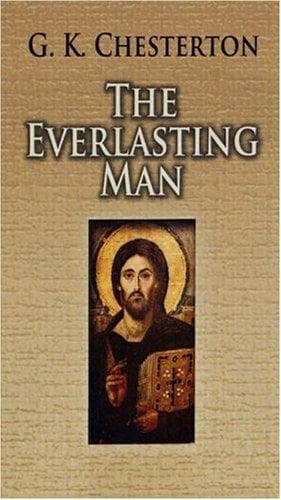
The Everlasting ManChesterton, G. K. (Gilbert Keith)
Religion
The Everlasting Man
Chesterton, G. K. (Gilbert Keith)
Catholic Church -- Apologetic works; Christianity and other religions; Religion
Polytheism, or that aspect of paganism, was never to the pagan what
Catholicism is to the Catholic. It was never a view of the universe
satisfying all sides of life; a complete and complex truth with
something to say about everything. It was only a satisfaction of one
side of the soul of man, even if we call it the religious side; and I
think it is truer to call it the imaginative side. But this it did
satisfy; in the end it satisfied it to satiety. All that world was a
tissue of interwoven tales and cults, and there ran in and out of it, as
we have already seen, that black thread among its more blameless
colours: the darker paganism that was really diabolism. But we all know
that this did not mean that all pagan men thought of nothing but pagan
gods. Precisely because mythology only satisfied one mood, they turned
in other moods to something totally different. But it is very important
to realise that it was totally different. It was too different to be
inconsistent. It was so alien that it did not clash. While a mob of
people were pouring on a public holiday to the feast of Adonis or the
games in honour of Apollo, this or that man would prefer to stop at home
and think out a little theory about the nature of things. Sometimes his
hobby would even take the form of thinking about the nature of God; or
even in that sense about the nature of the gods. But he very seldom
thought of pitting his nature of the gods against the gods of nature.
It is necessary to insist on this abstraction in the first student of
abstractions. He was not so much antagonistic as absent-minded. His
hobby might be the universe; but at first the hobby was as private as if
it had been numismatics or playing draughts. And even when his wisdom
came to be a public possession, and almost a political institution, it
was very seldom on the same plane as the popular and religious
institutions. Aristotle, with his colossal common sense, was perhaps the
greatest of all philosophers; certainly the most practical of all
philosophers. But Aristotle would no more have set up the Absolute side
by side with the Apollo of Delphi, as a similar or rival religion, than
Archimedes would have thought of setting up the Lever as a sort of idol
or fetish to be substituted for the Palladium of the city. Or we might
as well imagine Euclid building an altar to an isosceles triangle, or
offering sacrifices to the square on the hypotenuse. The one man
meditated on metaphysics as the other man did on mathematics; for the
love of truth or for curiosity or for the fun of the thing. But that
sort of fun never seems to have interfered very much with the other sort
of fun; the fun of dancing or singing to celebrate some rascally romance
about Zeus becoming a bull or a swan. It is perhaps the proof of a
certain superficiality and even insincerity about the popular
polytheism, that men could be philosophers and even sceptics without
disturbing it. These thinkers could move the foundations of the world
Public-domain text, read in full here on John Shaqi.
Reviews
Reviews
No reviews yet
Be the first to share your thoughts on this work.
Elsewhere in the archive
Join the Discussion
Join the discussion
Sign in to leave a comment or review.
Sign InorCreate an account