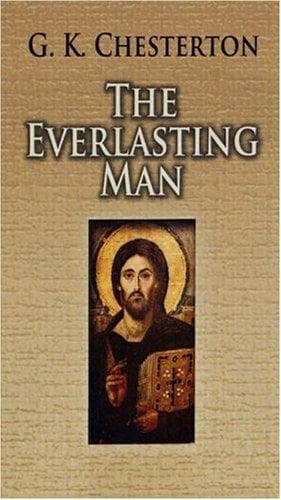
The Everlasting ManChesterton, G. K. (Gilbert Keith)
Religion
The Everlasting Man
Chesterton, G. K. (Gilbert Keith)
Catholic Church -- Apologetic works; Christianity and other religions; Religion
without altering even the outline of that coloured cloud that hung above
it in the air.
For the thinkers did move the foundations of the world; even when a
curious compromise seemed to prevent them from moving the foundations of
the city. The two great philosophers of antiquity do indeed appear to us
as defenders of sane and even of sacred ideas; their maxims often read
like the answers to sceptical questions too completely answered to be
always recorded. Aristotle annihilated a hundred anarchists and
nature-worshipping cranks by the fundamental statement that man is a
political animal. Plato in some sense anticipated the Catholic realism,
as attacked by the heretical nominalism, by insisting on the equally
fundamental fact that ideas are realities; that ideas exist just as men
exist. Plato however seemed sometimes almost to fancy that ideas exist
as men do not exist; or that the men need hardly be considered where
they conflict with the ideas. He had something of the social sentiment
that we call Fabian in his ideal of fitting the citizen to the city,
like an imaginary head to an ideal hat; and great and glorious as he
remains, he has been the father of all faddists. Aristotle anticipated
more fully the sacramental sanity that was to combine the body and the
soul of things; for he considered the nature of men as well as the
nature of morals, and looked to the eyes as well as to the light. But
though these great men were in that sense constructive and conservative,
they belonged to a world where thought was free to the point of being
fanciful. Many other great intellects did indeed follow them, some
exalting an abstract vision of virtue, others following more
rationalistically the necessity of the human pursuit of happiness. The
former had the name of Stoics; and their name has passed into a proverb
for what is indeed one of the main moral ideals of mankind: that of
strengthening the mind itself until it is of a texture to resist
calamity or even pain. But it is admitted that a great number of the
philosophers degenerated into what we still call sophists. They became a
sort of professional sceptics who went about asking uncomfortable
questions, and were handsomely paid for making themselves a nuisance to
normal people. It was perhaps an accidental resemblance to such
questioning quacks that was responsible for the unpopularity of the
great Socrates; whose death might seem to contradict the suggestion of
the permanent truce between the philosophers and the gods. But Socrates
did not die as a monotheist who denounced polytheism; certainly not as a
prophet who denounced idols. It is clear to any one reading between the
lines that there was some notion, right or wrong, of a purely personal
influence affecting morals and perhaps politics. The general compromise
remained; whether it was that the Greeks thought their myths a joke or
that they thought their theories a joke. There was never any collision
Public-domain text, read in full here on John Shaqi.
Reviews
Reviews
No reviews yet
Be the first to share your thoughts on this work.
Elsewhere in the archive
Join the Discussion
Join the discussion
Sign in to leave a comment or review.
Sign InorCreate an account