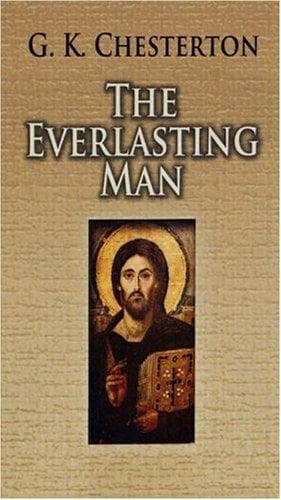
The Everlasting ManChesterton, G. K. (Gilbert Keith)
Religion
The Everlasting Man
Chesterton, G. K. (Gilbert Keith)
Catholic Church -- Apologetic works; Christianity and other religions; Religion
The next great example I shall take of the princely sage is Gautama, the
great Lord Buddha. I know he is not generally classed merely with the
philosophers; but I am more and more convinced, from all information
that reaches me, that this is the real interpretation of his immense
importance. He was by far the greatest and the best of these
intellectuals born in the purple. His reaction was perhaps the noblest
and most sincere of all the resultant actions of that combination of
thinkers and of thrones. For his reaction was renunciation. Marcus
Aurelius was content to say, with a refined irony, that even in a palace
life could be lived well. The fierier Egyptian king concluded that it
could be lived even better after a palace revolution. But the great
Gautama was the only one of them who proved he could really do without
his palace. One fell back on toleration and the other on revolution. But
after all there is something more absolute about abdication. Abdication
is perhaps the one really absolute action of an absolute monarch. The
Indian prince, reared in Oriental luxury and pomp, deliberately went out
and lived the life of a beggar. That is magnificent, but it is not war;
that is, it is not necessarily a Crusade in the Christian sense. It does
not decide the question of whether the life of a beggar was the life of
a saint or the life of a philosopher. It does not decide whether this
great man is really to go into the tub of Diogenes or the cave of St.
Jerome. Now those who seem to be nearest to the study of Buddha, and
certainly those who write most clearly and intelligently about him,
convince me for one that he was simply a philosopher who founded a
successful school of philosophy, and was turned into a sort of _divus_
or sacred being merely by the more mysterious and unscientific
atmosphere of all such traditions in Asia. So that it is necessary to
say at this point a word about that invisible yet vivid border-line
that we cross in passing from the Mediterranean into the mystery of the
East.
Public-domain text, read in full here on John Shaqi.
Reviews
Reviews
No reviews yet
Be the first to share your thoughts on this work.
Elsewhere in the archive
Join the Discussion
Join the discussion
Sign in to leave a comment or review.
Sign InorCreate an account