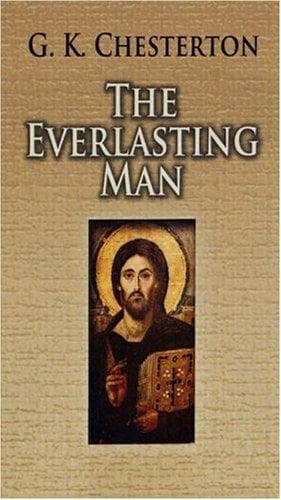
The Everlasting ManChesterton, G. K. (Gilbert Keith)
Religion
The Everlasting Man
Chesterton, G. K. (Gilbert Keith)
Catholic Church -- Apologetic works; Christianity and other religions; Religion
The most intense interest of the incident of Akhenaten, commonly called
the Heretic Pharaoh, lies in the fact that he was the one example, at
any rate before Christian times, of one of these royal philosophers who
set himself to fight popular mythology in the name of private
philosophy. Most of them assumed the attitude of Marcus Aurelius, who is
in many ways the model of this sort of monarch and sage. Marcus Aurelius
has been blamed for tolerating the pagan amphitheatre or the Christian
martyrdoms. But it was characteristic; for this sort of man really
thought of popular religion just as he thought of popular circuses. Of
him Professor Phillimore has profoundly said ‘a great and good man--and
he knew it.’ The Heretic Pharaoh had a philosophy more earnest and
perhaps more humble. For there is a corollary to the conception of being
too proud to fight. It is that the humble have to do most of the
fighting. Anyhow, the Egyptian prince was simple enough to take his own
philosophy seriously, and alone among such intellectual princes he
affected a sort of _coup d’état_; hurling down the high gods of Egypt
with one imperial gesture and lifting up for all men, like a blazing
mirror of monotheistic truth, the disc of the universal sun. He had
other interesting ideas often to be found in such idealists. In the
sense in which we speak of a Little Englander he was a Little Egypter.
In art he was a realist because he was an idealist; for realism is more
impossible than any other ideal. But after all there falls on him
something of the shadow of Marcus Aurelius; stalked by the shadow of
Professor Phillimore. What is the matter with this noble sort of prince
is that he has nowhere quite escaped being something of a prig.
Priggishness is so pungent a smell that it clings amid the faded spices
even to an Egyptian mummy. What was the matter with the Heretic Pharaoh,
as with a good many other heretics, was that he probably never paused to
ask himself whether there was _anything_ in the popular beliefs and
tales of people less educated than himself. And, as already suggested,
there was something in them. There was a real human hunger in all that
element of feature and locality, that procession of deities like
enormous pet animals, in that unwearied watching at certain haunted
spots, in all the mazy wandering of mythology. Nature may not have the
name of Isis; Isis may not be really looking for Osiris. But it is true
that Nature is really looking for something. Nature is always looking
for the supernatural. Something much more definite was to satisfy that
need; but a dignified monarch with a disc of the sun did not satisfy it.
The royal experiment failed amid a roaring reaction of popular
superstitions, in which the priests rose on the shoulders of the people
and ascended the throne of the kings.
Public-domain text, read in full here on John Shaqi.
Reviews
Reviews
No reviews yet
Be the first to share your thoughts on this work.
Elsewhere in the archive
Join the Discussion
Join the discussion
Sign in to leave a comment or review.
Sign InorCreate an account