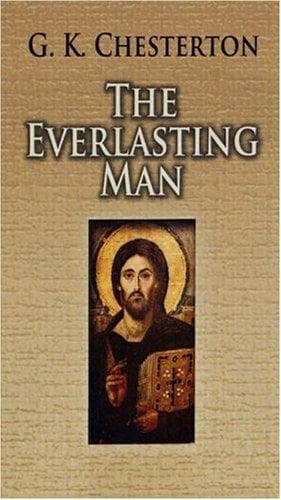
The Everlasting ManChesterton, G. K. (Gilbert Keith)
Religion
The Everlasting Man
Chesterton, G. K. (Gilbert Keith)
Catholic Church -- Apologetic works; Christianity and other religions; Religion
There was established on the opposite coast of the inland sea a city
that bore the name of the New Town. It was already much older, more
powerful, and more prosperous than the Italian town; but there still
remained about it an atmosphere that made the name not inappropriate. It
had been called new because it was a colony like New York or New
Zealand. It was an outpost or settlement of the energy and expansion of
the great commercial cities of Tyre and Sidon. There was a note of the
new countries and colonies about it; a confident and commercial outlook.
It was fond of saying things that rang with a certain metallic
assurance; as that nobody could wash his hands in the sea without the
leave of the New Town. For it depended almost entirely on the greatness
of its ships, as did the two great ports and markets from which its
people came. It brought from Tyre and Sidon a prodigious talent for
trade and considerable experience of travel. It brought other things as
well.
In a previous chapter I have hinted at something of the psychology that
lies behind a certain type of religion. There was a tendency in those
hungry for practical results, apart from poetical results, to call upon
spirits of terror and compulsion; to move Acheron in despair of bending
the gods. There is always a sort of dim idea that these darker powers
will really do things, with no nonsense about it. In the interior
psychology of the Punic peoples this strange sort of pessimistic
practicality had grown to great proportions. In the New Town, which the
Romans called Carthage, as in the parent cities of Phoenicia, the god
who got things done bore the name of Moloch, who was perhaps identical
with the other deity whom we know as Baal, the Lord. The Romans did not
at first quite know what to call him or what to make of him; they had to
go back to the grossest myth of Greek or Roman origins and compare him
to Saturn devouring his children. But the worshippers of Moloch were not
gross or primitive. They were members of a mature and polished
civilisation, abounding in refinements and luxuries; they were probably
far more civilised than the Romans. And Moloch was not a myth; or at any
rate his meal was not a myth. These highly civilised people really met
together to invoke the blessing of heaven on their empire by throwing
hundreds of their infants into a large furnace. We can only realise the
combination by imagining a number of Manchester merchants with
chimney-pot hats and mutton-chop whiskers, going to church every Sunday
at eleven o’clock to see a baby roasted.
Public-domain text, read in full here on John Shaqi.
Reviews
Reviews
No reviews yet
Be the first to share your thoughts on this work.
Elsewhere in the archive
Join the Discussion
Join the discussion
Sign in to leave a comment or review.
Sign InorCreate an account