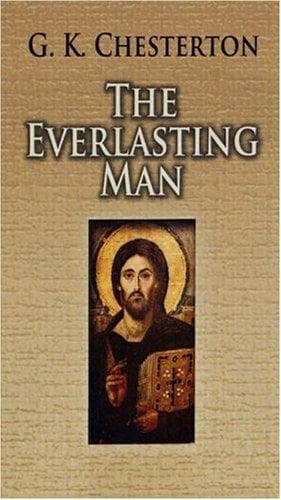
The Everlasting ManChesterton, G. K. (Gilbert Keith)
Religion
The Everlasting Man
Chesterton, G. K. (Gilbert Keith)
Catholic Church -- Apologetic works; Christianity and other religions; Religion
The first stages of the political or commercial quarrel can be followed
in far too much detail, precisely because it is merely political or
commercial. The Punic Wars looked at one time as if they would never
end; and it is not easy to say when they ever began. The Greeks and the
Sicilians had already been fighting vaguely on the European side against
the African city. Carthage had defeated Greece and conquered Sicily.
Carthage had also planted herself firmly in Spain; and between Spain and
Sicily the Latin city was contained and would have been crushed; if the
Romans had been of the sort to be easily crushed. Yet the interest of
the story really consists in the fact that Rome was crushed. If there
had not been certain moral elements as well as the material elements,
the story would have ended where Carthage certainly thought it had
ended. It is common enough to blame Rome for not making peace. But it
was a true popular instinct that there could be no peace with that sort
of people. It is common enough to blame the Roman for his _Delenda est
Carthago_; Carthage must be destroyed. It is commoner to forget that, to
all appearance, Rome itself was destroyed. The sacred savour that hung
round Rome for ever, it is too often forgotten, clung to her partly
because she had risen suddenly from the dead.
Carthage was an aristocracy, as are most of such mercantile states. The
pressure of the rich on the poor was impersonal as well as irresistible.
For such aristocracies never permit personal government, which is
perhaps why this one was jealous of personal talent. But genius can turn
up anywhere, even in a governing class. As if to make the world’s
supreme test as terrible as possible, it was ordained that one of the
great houses of Carthage should produce a man who came out of those
gilded palaces with all the energy and originality of Napoleon coming
from nowhere. At the worst crisis of the war, Rome learned that Italy
itself, by a military miracle, was invaded from the north. Hannibal, the
Grace of Baal as his name ran in his own tongue, had dragged a ponderous
chain of armaments over the starry solitudes of the Alps; and pointed
southward to the city which he had been pledged by all his dreadful gods
to destroy.
Public-domain text, read in full here on John Shaqi.
Reviews
Reviews
No reviews yet
Be the first to share your thoughts on this work.
Elsewhere in the archive
Join the Discussion
Join the discussion
Sign in to leave a comment or review.
Sign InorCreate an account