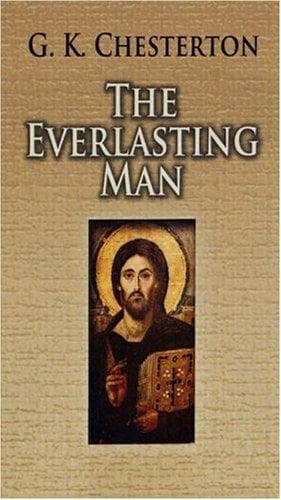
The Everlasting ManChesterton, G. K. (Gilbert Keith)
Religion
The Everlasting Man
Chesterton, G. K. (Gilbert Keith)
Catholic Church -- Apologetic works; Christianity and other religions; Religion
Why do men entertain this queer idea that what is sordid must always
overthrow what is magnanimous; that there is some dim connection between
brains and brutality, or that it does not matter if a man is dull so
long as he is also mean? Why do they vaguely think of all chivalry as
sentiment and all sentiment as weakness? They do it because they are,
like all men, primarily inspired by religion. For them, as for all men,
the first fact is their notion of the nature of things; their idea
about what world they are living in. And it is their faith that the only
ultimate thing is fear and therefore that the very heart of the world is
evil. They believe that death is stronger than life, and therefore dead
things must be stronger than living things; whether those dead things
are gold and iron and machinery or rocks and rivers and forces of
nature. It may sound fanciful to say that men we meet at tea-tables or
talk to at garden-parties are secretly worshippers of Baal or Moloch.
But this sort of commercial mind has its own cosmic vision and it is the
vision of Carthage. It has in it the brutal blunder that was the ruin of
Carthage. The Punic power fell, because there is in this materialism a
mad indifference to real thought. By disbelieving in the soul, it comes
to disbelieving in the mind. Being too practical to be moral, it denies
what every practical soldier calls the moral of an army. It fancies that
money will fight when men will no longer fight. So it was with the Punic
merchant princes. Their religion was a religion of despair, even when
their practical fortunes were hopeful. How could they understand that
the Romans could hope even when their fortunes were hopeless? Their
religion was a religion of force and fear; how could they understand
that men can still despise fear even when they submit to force? Their
philosophy of the world had weariness in its very heart; above all they
were weary of warfare; how should they understand those who still wage
war even when they are weary of it? In a word, how should they
understand the mind of Man, who had so long bowed down before mindless
things, money and brute force and gods who had the hearts of beasts?
They awoke suddenly to the news that the embers they had disdained too
much even to tread out were again breaking everywhere into flame; that
Hasdrubal was defeated, that Hannibal was outnumbered, that Scipio had
carried the war into Spain; that he had carried it into Africa. Before
the very gates of the golden city Hannibal fought his last fight for it
and lost; and Carthage fell as nothing has fallen since Satan. The name
of the New City remains only as a name. There is no stone of it left
upon the sand. Another war was indeed waged before the final
destruction: but the destruction was final. Only men digging in its deep
foundations centuries after found a heap of hundreds of little
skeletons, the holy relics of that religion. For Carthage fell because
Public-domain text, read in full here on John Shaqi.
Reviews
Reviews
No reviews yet
Be the first to share your thoughts on this work.
Elsewhere in the archive
Join the Discussion
Join the discussion
Sign in to leave a comment or review.
Sign InorCreate an account