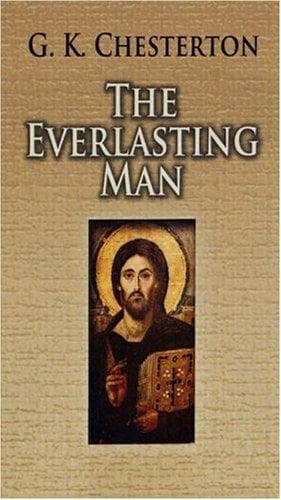
The Everlasting ManChesterton, G. K. (Gilbert Keith)
Religion
The Everlasting Man
Chesterton, G. K. (Gilbert Keith)
Catholic Church -- Apologetic works; Christianity and other religions; Religion
she was faithful to her own philosophy and had followed out to its
logical conclusion her own vision of the universe. Moloch had eaten his
children.
The gods had risen again, and the demons had been defeated after all.
But they had been defeated by the defeated, and almost defeated by the
dead. Nobody understands the romance of Rome, and why she rose
afterwards to a representative leadership that seemed almost fated and
fundamentally natural, who does not keep in mind the agony of horror and
humiliation through which she had continued to testify to the sanity
that is the soul of Europe. She came to stand alone in the midst of an
empire because she had once stood alone in the midst of a ruin and a
waste. After that all men knew in their hearts that she had been
representative of mankind, even when she was rejected of men. And there
fell on her the shadow from a shining and as yet invisible light and the
burden of things to be. It is not for us to guess in what manner or
moment the mercy of God might in any case have rescued the world; but it
is certain that the struggle which established Christendom would have
been very different if there had been an empire of Carthage instead of
an empire of Rome. We have to thank the patience of the Punic wars if,
in after ages, divine things descended at least upon human things and
not inhuman. Europe evolved into its own vices and its own impotence, as
will be suggested on another page; but the worst into which it evolved
was not like what it had escaped. Can any man in his senses compare the
great wooden doll, whom the children expected to eat a little bit of the
dinner, with the great idol who would have been expected to eat the
children? That is the measure of how far the world went astray, compared
with how far it might have gone astray. If the Romans were ruthless, it
was in a true sense to an enemy, and certainly not merely a rival. They
remembered not trade routes and regulations, but the faces of sneering
men; and hated the hateful soul of Carthage. And we owe them something
if we never needed to cut down the groves of Venus exactly as men cut
down the groves of Baal. We owe it partly to their harshness that our
thoughts of our human past are not wholly harsh. If the passage from
heathenry to Christianity was a bridge as well as a breach, we owe it to
those who kept that heathenry human. If, after all these ages, we are in
some sense at peace with paganism, and can think more kindly of our
fathers, it is well to remember the things that were and the things that
might have been. For this reason alone we can take lightly the load of
antiquity and need not shudder at a nymph on a fountain or a cupid on a
valentine. Laughter and sadness link us with things long past away and
remembered without dishonour; and we can see not altogether without
tenderness the twilight sinking around the Sabine farm and hear the
household gods rejoice when Catullus comes home to Sirmio. _Deleta est
Carthago._
Public-domain text, read in full here on John Shaqi.
Reviews
Reviews
No reviews yet
Be the first to share your thoughts on this work.
Elsewhere in the archive
Join the Discussion
Join the discussion
Sign in to leave a comment or review.
Sign InorCreate an account