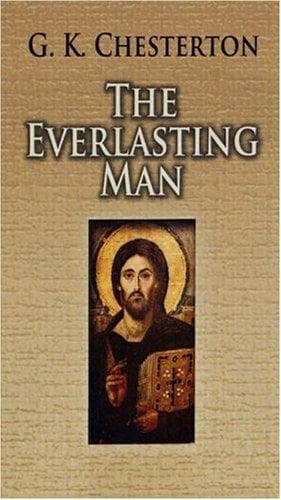
The Everlasting ManChesterton, G. K. (Gilbert Keith)
Religion
The Everlasting Man
Chesterton, G. K. (Gilbert Keith)
Catholic Church -- Apologetic works; Christianity and other religions; Religion
That insane image of the Kentish church standing on the point of its
spire, as in some old rustic topsy-turvy tale, always comes back into my
imagination when I hear these things said about pagan origins; and calls
to my aid the laughter of the giants. Then I feel as genially and
charitably to all other scientific investigators, higher critics, and
authorities on ancient and modern religion, as I do to poor Louis de
Rougemont. But the memory of that immense absurdity remains as a sort of
measure and check by which to keep sane, not only on the subject of
Christian churches, but also on the subject of heathen temples. Now a
great many people have talked about heathen origins as the distinguished
traveller talked about Christian origins. Indeed a great many modern
heathens have been very hard on heathenism. A great many modern
humanitarians have been very hard on the real religion of humanity. They
have represented it as being everywhere and from the first rooted only
in these repulsive arcana; and carrying the character of something
utterly shameless and anarchical. Now I do not believe this for a
moment. I should never dream of thinking about the whole worship of
Apollo what De Rougemont could think about the worship of Christ. I
would never admit that there was such an atmosphere in a Greek city as
that madman was able to smell in a Kentish village. On the contrary, it
is the whole point, even of this final chapter upon the final decay of
paganism, to insist once more that the worst sort of paganism had
already been defeated by the best sort. It was the best sort of paganism
that conquered the gold of Carthage. It was the best sort of paganism
that wore the laurels of Rome. It was the best thing the world had yet
seen, all things considered and on any large scale, that ruled from the
wall of the Grampians to the garden of the Euphrates. It was the best
that conquered; it was the best that ruled; and it was the best that
began to decay.
Unless this broad truth be grasped, the whole story is seen askew.
Pessimism is not in being tired of evil but in being tired of good.
Despair does not lie in being weary of suffering, but in being weary of
joy. It is when for some reason or other the good things in a society no
longer work that the society begins to decline; when its food does not
feed, when its cures do not cure, when its blessings refuse to bless. We
might almost say that in a society without such good things we should
hardly have any test by which to register a decline; that is why some of
the static commercial oligarchies like Carthage have rather an air in
history of standing and staring like mummies, so dried up and swathed
and embalmed that no man knows when they are new or old. But Carthage
at any rate was dead, and the worst assault ever made by the demons on
mortal society had been defeated. But how much would it matter that the
worst was dead if the best was dying?
Public-domain text, read in full here on John Shaqi.
Reviews
Reviews
No reviews yet
Be the first to share your thoughts on this work.
Elsewhere in the archive
Join the Discussion
Join the discussion
Sign in to leave a comment or review.
Sign InorCreate an account