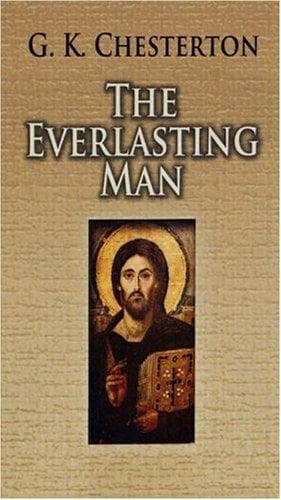
The Everlasting ManChesterton, G. K. (Gilbert Keith)
Religion
The Everlasting Man
Chesterton, G. K. (Gilbert Keith)
Catholic Church -- Apologetic works; Christianity and other religions; Religion
To begin with, it must be noted that the relation of Rome to Carthage
was partially repeated and extended in her relation to nations more
normal and more nearly akin to her than Carthage. I am not here
concerned to controvert the merely political view that Roman statesmen
acted unscrupulously towards Corinth or the Greek cities. But I am
concerned to contradict the notion that there was nothing but a
hypocritical excuse in the ordinary Roman dislike of Greek vices. I am
not presenting these pagans as paladins of chivalry, with a sentiment
about nationalism never known until Christian times. But I am presenting
them as men with the feelings of men; and those feelings were not a
pretence. The truth is that one of the weaknesses in nature-worship and
mere mythology had already produced a perversion among the Greeks, due
to the worst sophistry; the sophistry of simplicity. Just as they became
unnatural by worshipping nature, so they actually became unmanly by
worshipping man. If Greece led her conqueror, she might have misled her
conqueror; but these were things he did originally wish to conquer--even
in himself. It is true that in one sense there was less inhumanity even
in Sodom and Gomorrah than in Tyre and Sidon. When we consider the war
of the demons on the children, we cannot compare even Greek decadence to
Punic devil-worship. But it is not true that the sincere revulsion from
either need be merely pharisaical. It is not true to human nature or to
common sense. Let any lad who has had the luck to grow up sane and
simple in his day-dreams of love hear for the first time of the cult of
Ganymede; he will not be merely shocked but sickened. And that first
impression, as has been said here so often about first impressions, will
be right. Our cynical indifference is an illusion; it is the greatest
of all illusions: the illusion of familiarity. It is right to conceive
the more or less rustic virtues of the ruck of the original Romans as
reacting against the very rumour of it, with complete spontaneity and
sincerity. It is right to regard them as reacting, if in a lesser
degree, exactly as they did against the cruelty of Carthage. Because it
was in a less degree they did not destroy Corinth as they destroyed
Carthage. But if their attitude and action was rather destructive, in
neither case need their indignation have been mere self-righteousness
covering mere selfishness. And if anybody insists that nothing could
have operated in either case but reasons of state and commercial
conspiracies, we can only tell him that there is something which he does
not understand; something which possibly he will never understand;
something which, until he does understand, he will never understand the
Latins. That something is called democracy. He has probably heard the
word a good many times and even used it himself; but he has no notion of
what it means. All through the revolutionary history of Rome there was
Public-domain text, read in full here on John Shaqi.
Reviews
Reviews
No reviews yet
Be the first to share your thoughts on this work.
Elsewhere in the archive
Join the Discussion
Join the discussion
Sign in to leave a comment or review.
Sign InorCreate an account