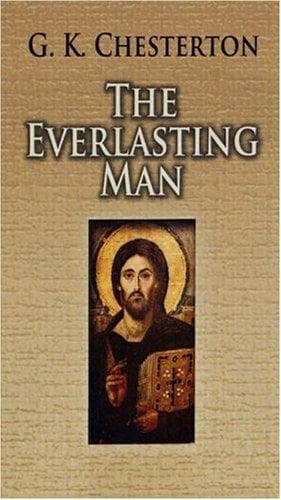
The Everlasting ManChesterton, G. K. (Gilbert Keith)
Religion
The Everlasting Man
Chesterton, G. K. (Gilbert Keith)
Catholic Church -- Apologetic works; Christianity and other religions; Religion
weary of being a robber or a Red Indian. It is then that he torments the
cat. There comes a time in the routine of an ordered civilisation when
the man is tired of playing at mythology and pretending that a tree is a
maiden or that the moon made love to a man. The effect of this staleness
is the same everywhere; it is seen in all drug-taking and dram-drinking
and every form of the tendency to increase the dose. Men seek stranger
sins or more startling obscenities as stimulants to their jaded sense.
They seek after mad oriental religions for the same reason. They try to
stab their nerves to life, if it were with the knives of the priests of
Baal. They are walking in their sleep and try to wake themselves up with
nightmares.
At that stage even of paganism therefore the peasant songs and dances
sound fainter and fainter in the forest. For one thing, the peasant
civilisation was fading, or had already faded, from the whole
countryside. The Empire at the end was organised more and more on that
servile system which generally goes with the boast of organisation;
indeed it was almost as servile as the modern schemes for the
organisation of industry. It is proverbial that what would once have
been a peasantry became a mere populace of the town dependent for bread
and circuses; which may again suggest to some a mob dependent upon doles
and cinemas. In this as in many other respects, the modern return to
heathenism has been a return not even to the heathen youth but rather to
the heathen old age. But the causes of it were spiritual in both cases;
and especially the spirit of paganism had departed with its familiar
spirits. The heart had gone out of it with its household gods, who went
along with the gods of the garden and the field and the forest. The Old
Man of the Forest was too old; he was already dying. It is said truly in
a sense that Pan died because Christ was born. It is almost as true in
another sense that men knew that Christ was born because Pan was already
dead. A void was made by the vanishing of the whole mythology of
mankind, which would have asphyxiated like a vacuum if it had not been
filled with theology. But the point for the moment is that the mythology
could not have lasted like a theology in any case. Theology is thought,
whether we agree with it or not. Mythology was never thought, and nobody
could really agree with it or disagree with it. It was a mere mood of
glamour, and when the mood went it could not be recovered. Men not only
ceased to believe in the gods, but they realised that they had never
believed in them. They had sung their praises; they had danced round
their altars. They had played the flute; they had played the fool.
Public-domain text, read in full here on John Shaqi.
Reviews
Reviews
No reviews yet
Be the first to share your thoughts on this work.
Elsewhere in the archive
Join the Discussion
Join the discussion
Sign in to leave a comment or review.
Sign InorCreate an account